Savannification and invasive worms (part 2 of 2): Responding to (many) messages about worms and landscape change!
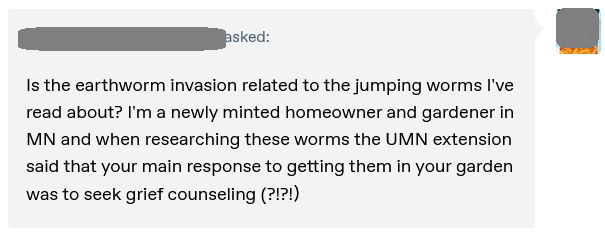
(Originally posted elsewhere on 4 December 2019.)
G U E S S A G A I N

Jokes aside, I still rescue earthworms from sidewalks and have since I was a child in our little informal, weird-girl, after-school bug-club, as I’m sure many of us did and still do. All life has value. (Still feeling confused about the ethical/ecological implications of rescuing non-native worms. When so many United States cities present as sanitized, sterilized, anonymous concrete-asphalt landscapes - covered in manicured non-native grass lawns - are the already-firmly-entrenched non-native earthworms causing much more damage in residential lawns if you save a few, so long as you avoid introducing them to intact ecological sites outside city limits? No pun intended, but that discourse is a whole other can of worms. Discussion for another time.) So I’ve seen some disparaging remarks made about the Moral Character of non-native earthworms, so obligatory statement: Earthworms of course are not villains or actively malevolent. Colonization; Indigenous dispossession; empire; profit-oriented thinking; industrial monoculture; large-scale geoengineering over years to reshape the entirety of the Turtle Island and Latin American landscapes as if they were “bountiful” European farms populated by “familiar and comforting” European species, etc. - earthworms are a physical manifestation of those issues.
AND, importantly, they've been so entrenched for so long that you might try to limit northward expansion but otherwise they're here--like it or not.
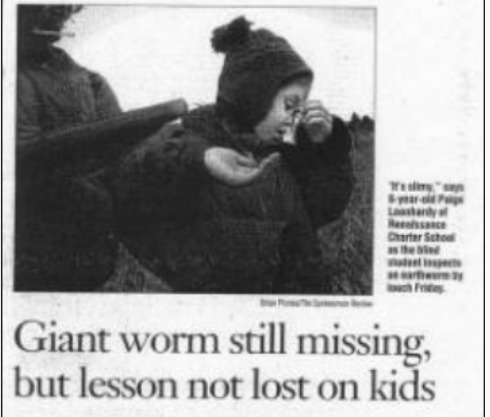
[Spokesman Review - 20 November 1999. Andrea Vogt, staff writer.]
Two of the largest and most iconic native earthworms on the continent are actually found west of the Rockies. Shout-out to [a commenter] for explicitly name-dropping the beautiful and alluring Palouse giant earthworm (Driloleirus americanus), a rare and elusive species, one of the earthworm species actually native west of the Rockies (from the Washington-Idaho border in the Inland Northwest). It lives in the Palouse Hills; in the nearby Nez Perce Prairie and Lower Clearwater canyon system; and in some sites in Washington’s East Cascades ecoregion. Much of the Palouse has been converted to agriculture, damaging the soil, and the worm was apparently missing for decades until recent encounters confirmed that it’s still alive. The Palouse giant earthworm and the endangered Oregon giant earthworm (Driloleirus macelfreshi) - from prairie-oak woodland of Willamette Valley - are both contenders for the title of “largest native earthworm in North America.”
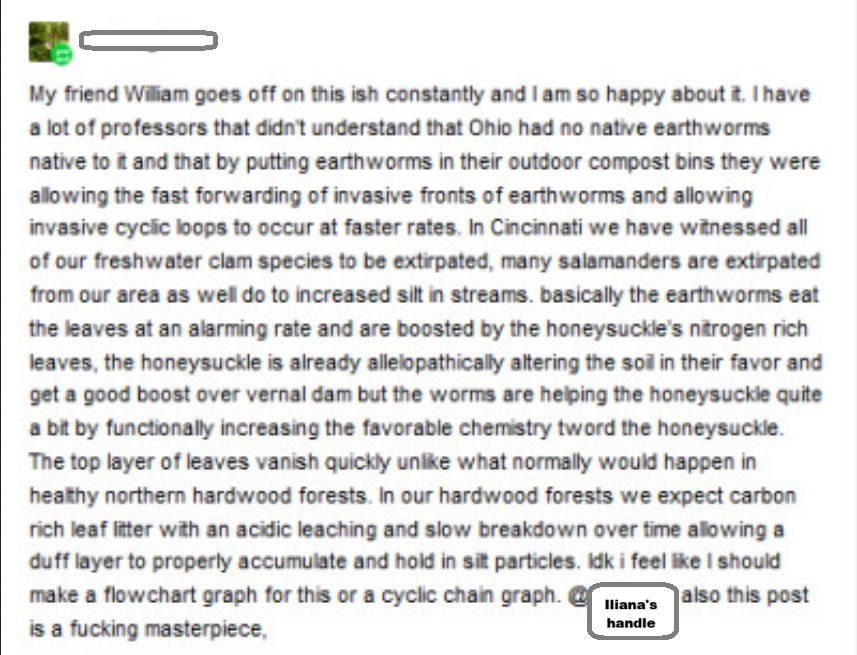
Excellent info (he's a friend of mine, and is botanist/faculty member):
And thank you:
Nice to hear some info on boreal environments, thank you. This is somewhat similar to how tiger salamanders (Ambystoma tigrinum and A. mavoritum) - native in North America east of the Great Basin - were artificially introduced to Mediterranean California: People were importing salamander larvae as fishing bait. (Pretty brutal to begin with, if you ask me.) And now the iconic, unique California tiger salamander (Ambystoma californiense) - endemic only to California and which was already endangered - is forced to directly compete to reclaim its own oak woodland and chaparral habitat from its introduced relative.
And we can’t let older United States land management agencies and institutions off the hook for stocking non-native sport fish species in watersheds of the American West, followed by the stocking of non-native crustaceans to feed the fish.
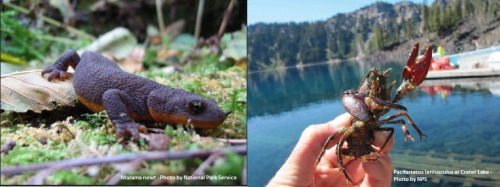
A couple of weeks ago, did you see my post about the Mazama newt? The newt's endemic to Crater Lake (PNW/Oregon) and is driven to decline by the voracious introduced crayfish species Pacifastacus leniusculus.
On that note, regarding earthworm introduction as a means to improve your own access to food (via garden) or food (via using them as fishing bait): I did definitely see some people being serious about this, so it’s worth noting the irony of a well-meaning action which nevertheless deliberately introduces European species, erasing/degrading native ecology, and also resulting in the destruction of Indigenous foodsheds.

Right! Sugar maple is one of the plant species most susceptible to earthworm-induced soil change.
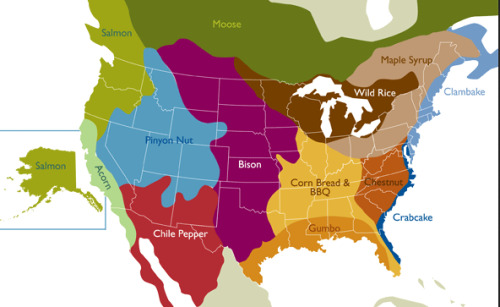
Even the "native foodways" map most circulated emphasizes the significance of sugar maple for Nishnaabe (and other peoples') traditional food:
(Update from many months later when I got a message in my inbox.)
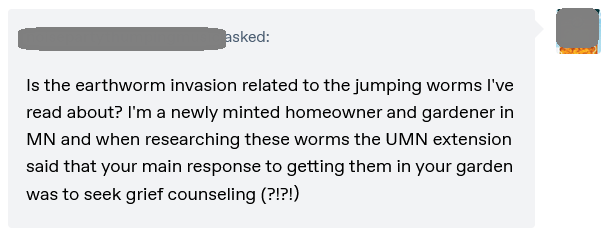
Lol. But no, these are two different and distinct worm invasions.
We were talking about northward expansion of non-native European nightcrawler earthworms (Lumbricus genus).
And there is a more recent continent-wide invasion of the rapidly-proliferating and voracious non-native jumping worms (Amynthas genus).
The “jumping worm” invasion is a newer phenomenon; this invasion is publicized dramatically, and is dire, partially (1) because of their tendency to remain at the surface of the soil, consuming and destroying 95% of leaf litter; and partially (2) because they’ve expanded so rapidly in only the last few years/decades (they have the ability to expand distribution range much, much faster than classic earthworms).
Even in urban landscapes in the US, these worms threaten gardens. Jumping worms arrived and established themselves only in recent decades, after the 1930s, apparently mostly through their use as fishing bait and, especially, due to their use in compost piles. Jumping worms come from Korea and Japan. They are also referred to as Alabama jumpers. They apparently spread mostly through compost and through the soil of potted/landscaping plants.
The classic nightcrawlers apparently move about 10 meters per year.
The jumping worms can expand across 17 acres (13 gridiron football fields) in a single spring/summer season.
Jumping worms can consume/destroy 95% or more of all leaf litter where they live, meaning the death of soil microorganisms and fungal/mychorrizal networks.
This means that fungus loses most of the detritus it would otherwise consume/convert. But the loss of leaf litter also means the almost total destruction of microhabitat for millipedes, bugs, etc., but also for vertebrates like frogs, toads, and salamanders, etc.
Unlike nightcrawlers, jumping worms remain near the surface. This also prevents plants from taking root. Jumping worm cocoons can hide unhatched in soil for many months and can survive temperatures between negative-fifteen and one hundred degrees Fahrenheit.
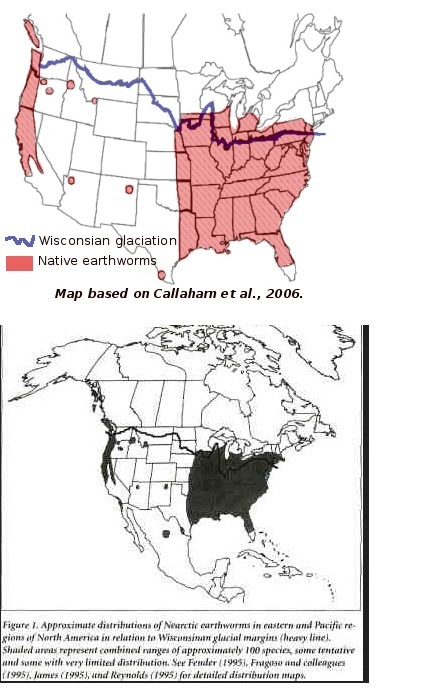
Here's the general distribution range of native earthworms in North America:
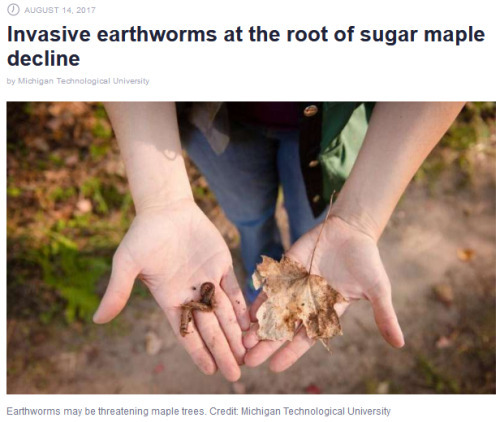
So headlines and consequences like this involve the European nightcrawlers; though they've been in North America for a couple of centuries, their more recent expansion into the boreal forest zone is a concern:
But.
In comparison.
Here's a look at the distinct jumping worm problem:
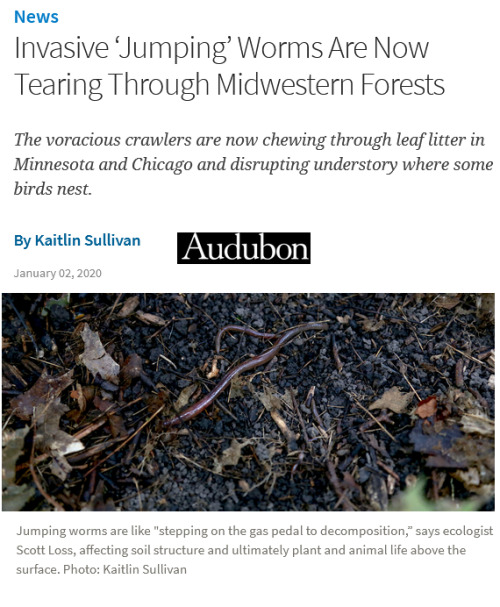
Jumping worms began receiving a lot more publicity in media in 2019 and 2020, once it became clear that the worms had firmly established themselves in Iowa, Illinois, Wisconsin, and Minnesota (the same regions of the Upper Midwest and Great Lakes where nightcrawler expansion is already a danger).
And yea, the University of Minnesota’s online sites contain some of the best and most accessible information on both Lumbricus nightcrawlers and also on the danger of Amynthas jumping worms.