Sources on imperial Japan's use of forestry management as a tool of colonial expansion and 'ecological imperialism' (and post-war Korea's inheritance)
(Originally posted elsewhere on 3 October 2021.)
First, a list of sources.
Then, an excerpt of an interview with David Feldman, author Seeds of Control: Japan’s Empire of Forestry in Colonial Korea (University of Washington Press, 2020). Feldman describes utilitarian concerns and the Japanese institutional/state adoption of US/European paradigms of “scientific forestry,” then translated and applied to Japanese holdings in Korea (though, elsewhere, you can also read about Japan practicing similar land management in its colonies of Southeast Asia). He also describes the persistent of “beautification” campaigns even among nominally independent Korea “on either side of 1945,” and how “Cold War context, authoritarian rule and energy portfolio” in mid-century Korea inherited those frameworks in the midst of “draconian” programs of “caloric control.” Finally, Feldman proposes the utility of what we might call a geographic (speaking of the academic discipline) perspective on imperial histories: “We have much to gain by looking beyond the boundaries of Japan to write its environmental history.”
—
On the role of forestry, “nature”, and “environmentalism” in service of 19th- and 20th-century Japanese imperialism:
Koji Nakashima. “Nationalism, colonialism and the representation of nature: forest and country in the afforestation campaign in modern Japan.” 2nd International Critical Geography Conference. 2000.
Tessa Morris-Suzuki. “Sustainability and Ecological Imperialism in Edo Period Japan.” Japanese Studies 16:1. 1995.
Tessa Morris-Suzuki. “The Nature of Empire: Forest Ecology, Colonialism and Survival Politics in Japan’s Imperial Order.” Japanese Studies 33:3. 2013.
Tessa Morris-Suzuki. “Indigenous Knowledge in the Mapping of the Northern Frontier Regions.” In: Cartographic Japan: A History in Maps. Edited by Sugimoto Fumiko, Karen Wigen, and Cary Karacas. 2016.
Tessa Morris-Suzuki. “Indigenous diplomacy: Sakhalin Ainu (enchiw) in the shaping of modern East Asia.” Part 1 (”Traders and Travelers”): The Asia-Pacific Journal: Japan Focus 18, 22. 2020. Part 2 (”Voices and silences”): The Asia-Pacific Journal: Japan Focus 18, 23. 2020.
Akihisa Setoguchi. “Control of Insect Vectors in the Japanese Empire: Transformation of the Colonial / Metropolitan Environment.” East Asian Science, Technology and Society 1:2. 2007.
Gregory Barton. Empire Forestry and the Origins of Environmentalism. Cambridge University Press. 2002.
Taisaku Komeie. “Colonial Environmentalism and Shifting Cultivation in Korea: Japanese Mapping, Research and Representation.” Geographical Review of Japan 79:12. 2006.
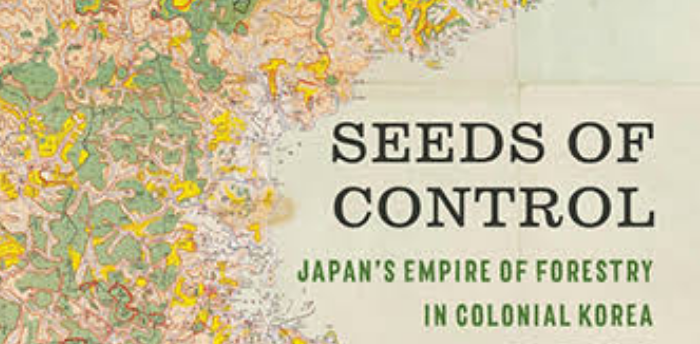
David Fedman. Seeds of Control: Japan’s Empire of Forestry in Colonial Korea. University of Washington Press. 2020.
—
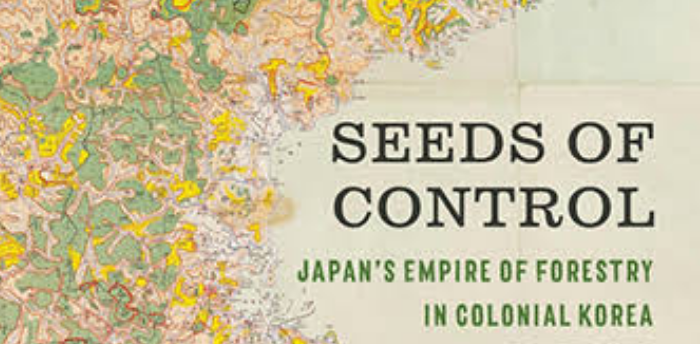
(Detail of Feldmans’ book cover.)
Excerpt:
Driven by utilitarian concerns with scarcity and fears of cascading environmental degradation, colonial officials implemented tree-planting programs of all sorts -- seed farms, erosion control projects, school forests and so on. [...] Imperial forestry describes a shared set of practices, convictions and institutions that bound Japanese forestry professionals into a network that spanned the Japanese empire itself. [...] Japanese woodsmen (with a venerable forestry tradition all their own) came to terms with Western notions of natural resource management and "scientific forestry." [...] Japanese foresters tailored European ideas about ecology, sustainability, and industrial development to the particular needs of the Japanese empire and the different biomes it encompassed. [...] Japan has played an outsized role in the management and control of Asia's forests. To understand how Japan has maintained such verdant hillsides at home, [...] we need to more fully appreciate its control of sylvan landscapes abroad -- be they in the colonial empire before 1945 or in Southeast Asia thereafter. [...] [W]e ought to place tenant farmers in colonial Korea and shifting cultivators in Kalimantan in the same analytical frame. [...]
As part of a campaign to supposedly "beautify" the Korean landscape [...], Japanese settlers planted [...] cherry blossoms along streets, in squares, and within parks across Korea. [...] Another impact can be found in the forestry institutions founded during colonial rule. The flagship Forestry Research Station established by the colonial government, for example, only grew after liberation, becoming a hub of agro-forestry research that underpinned South Korea's economic take-off under Park Chung-hee. Many of the architects of South Korea's so-called "forest miracle" -- the wildly successful project of reforestation in the 1960s and 70s -- were trained in colonial scientific institutions. This is not to suggest that the dense forests that today blanket South Korea are somehow due to colonial rule. Reforestation under Park was born of markedly different circumstances -- its Cold War context, authoritarian rule and energy portfolio. But that doesn't mean that foresters on either side of 1945 weren't united by the same sets of anxieties and aspirations. [...] [A] set of abiding concerns [...] have animated forest conservation measures across the full sweep of the tumultuous twentieth century in Korea. [...]
[R]eferences to the ondol (the radiant heated floors conventional to Korean dwellings) are everywhere in the forester’s archive. Japanese woodsmen quickly marked the ondol and its associated lifestyle as ground zero of deforestation. By the 1920s, forestry officials had launched an ambitious campaign to gain control over the energy consumption patterns of the home -- a crusade on caloric inefficiency that furthered the reach of the colonial state into the domestic sphere. In this sense, the ondol provides an illuminating lens through which to examine how forestry touched the lived, even bodily, experience of colonial rule in a sometimes bitterly cold environment. This is especially true of the civilian experience of the Asia-Pacific War in Korea, a period of fuel scarcity that resulted in draconian programs of caloric control. [...]
[W]e have much to gain by looking beyond the boundaries of the islands of Japan to write its environmental history. Understanding the tree-smothered hillsides of the so-called “green archipelago” requires that we pay close attention to its material linkages with the rest of Asia. It demands that we track commodity chains, supply lines, and resource politics across the Pacific.
Text above are the words of David Feldman, as interviewed and transcribed by the Office of the Dean, School of Humanities at University of California, Irvine. Transcript titled “Seeing the forest for the trees.” Published online in the News section of UCI School of Humanities. 21 May 2020.