'Temporal dispossession' in the Congo, French finance in West Africa, and the coltan price-spike for metropolitan video game products at Christmastime 2000: In conversation

(Congo post originally from 8 May 2022; French finance post originally from 18 April 2023.)
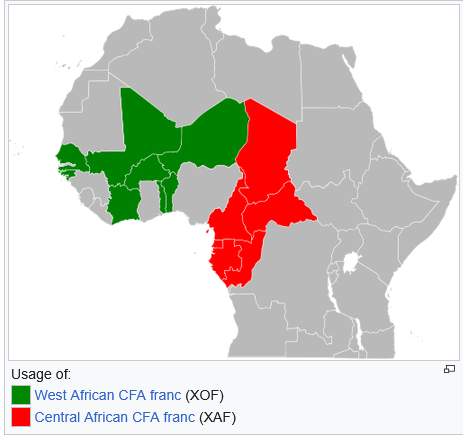
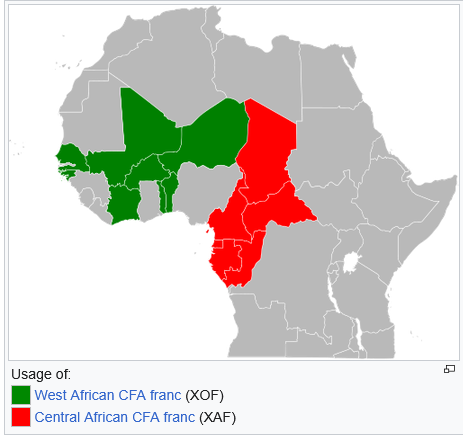
(Image added 2026. Image by Jarry1250, a Wikimedia Commons user, uploaded 18 August 2011 and released into the public domain at: https://commons.wikimedia.org/wiki/File:CFA_Franc_map.svg)
Just putting scholars’ work in conversation, side-by-side, to bridge lessons from ethnographic and imperial history frameworks, respectively. Regarding forms of both physical/material and imaginative/temporal coloniality persisting after formal “decolonization” in late twentieth-century Africa.
—
[I]n poststructural adjustment Africa, established ways of getting ahead and getting by were sabotaged, producing a sense of ruptured temporality and reversed or forestalled “development” [...]. The West Africanist Jane Guyer has argued that the erasure of incremental time is a global phenomenon: the precarity brought about by neoliberalism [...] leaving us [...] with the instantaneous now (“punctuated time”) [...]. Ferguson’s pioneering work examines how colonial era social investment in African mining underpinned an expectation of the longue duree, and of mining futures now past (Ferguson 1999, 2006). The historic, neoliberal shift from socially and temporally “thick” to socially “thin,” hit-and-run extraction informed a number of other changes related to work and time in Africa, including the concentration of political sovereignty around “mining enclaves” [...]. [E]xtractive economy in tantalum, tin, and tungsten (referred to in NGO circles as the “3 Ts”) shapes experiences and understandings of space, time, and value in the Eastern DR Congo. [...] Much of this product is eventually sold to electronics manufacturers, ending up in many high tech devices. All of these aforementioned substances are essential to digital devices: tantalum is needed to produce digital capacitors [...]. Tungsten is found in laptop screens and is used to make cell phones vibrate [...]. Global demand for tantalum increased by 24 percent per year during the 1990s, alongside the emergence of the “information age” […]. [T]hese minerals’ prices are also strongly influenced by digital cultures. Congolese “3 Ts” are traded on spot markets, so their values fluctuate radically and rapidly: for example, online speculation helped produce the spike in coltan prices in late 2000, when Sony ran out of the tantalum it needed to meet Christmas demand for PlayStation 2 [...]. The rupture of incremental time and predictable work is central to the experiences of those involved [...]. [This is a] process of “temporal dispossession” in Congolese mining areas - or the usurpation, by others, of the ability to produce social relations [...]. [M]any Eastern Congolese experience war as the instrument [...], and time and price are among the many “resources” through which war is carried out. Transnational networks [...] have expropriated Congolese resources [...].
Text above by: James H. Smith, “‘May it never end’: Price wars, networks, and temporality in the ‘3 Ts’ mining trade of the Eastern DR Congo,” HAU: Journal of Ethnographic Theory, vol. 5, no. 1 (2015). DOI: https://doi.org/10.14318/hau5.1.002 [Emphasis mine.]
—
The franc CFA […] monetary system and its history are the subjects of a new book by Fanny Pigeaud and Ndongo Samba Sylla, Africa’s Last Colonial Currency (2021), translated by Thomas Fazi from a 2018 French edition. The book brings to the attention of Anglophone readers the peculiar institutions through which the French Republic continues to exercise colonial rule over nominally independent African states. […] One of Pigeaud and Sylla’s commitments and achievements is to show how “French ‘soft’ monetary power is inseparable from its ‘hard’ military power” (2021: 99). In their telling, the CFA franc has for decades been France’s secret weapon in “Françafrique” […]. The franc CFA was born in Paris on the 25th of December, 1945 [...]. The embattled empire was compelled to “loosen its grip” in Africa […]. Consequently, argue Pigeaud and Sylla, the creation of the CFA franc was “actually designed to allow France to regain control of its colonies” (13). What Minister Pleven called generosity might better be called a swindle. [...] French goods-for-export, now priced in a devalued currency (made cheaper), would find easy markets in the colonies [...]. African goods - especially important raw materials, from uranium to cocoa, priced too expensively for domestic consumption [...] -- would find buyers more exclusively in France [...]. In effect, the new CFA monetary policies re-consolidated France’s imperial economy even as the monopoly regime of the colonial pact could be formally retired in recognition of demands for change from colonial subjects. [...] [T]he egalitarian parlance of community and cooperation modernized French colonial authority, making it more invisible rather than marking its end. [...] Most importantly, France has held up a guarantee of unlimited convertibility between CFA francs and French currency [as its so-called most benevolent feature] [...]. [But] CFA francs can only ever be converted into France’s currency [...] before being exchanged for other currencies [...]. In 1994, in conjunction with the International Monetary Fund and against the wishes of most African leaders, French authorities adjusted the franc zone exchange rate for the first time, devaluing the CFA franc by half. This blanket devaluation was the shock through which structural adjustment was forced upon Françafrique [...]. And the devaluation proved, to Pigeaud and Sylla, that France’s “‘guarantee of unlimited convertibility’ was an intellectual and political fraud” (74). Nevertheless, French authorities have continually held up - that is, brandished and exploited - this guarantee, without honoring it. [...] In that respect, the CFA franc system has ensured [...] the stabilization of raw material exportation and goods importation, hierarchy and indirect rule, [...] accumulation […]. The CFA franc has been central to the French strategy of decolonization-in-name-only. [...] In 1958, Ahmed Sékou Touré helped lead Guinea to independence [...]. Guinea was alone in voting down De Gaulle’s “Community” proposal [...], and [...] the new state established its own national currency and central bank by 1960. [...] [T]he decision was ultimately made to make Guinea a cautionary tale for the rest of Françafrique.
Text above by: Matt Schneider, “Africa’s Last Colonial Currency Review,” Society and Space [Book Reviews section of the online Magazine format] (29 November 2021). URL: https://www.societyandspace.org/articles/africas-last-colonial-currency-review [Emphasis mine.]