Temporal frontiers of empire, geology, and curious intrusions of British authors in the 'first' dinosaur

Curious intrusions of famous authors (Dickens, Darwin, Thackeray, Poe) encountered when thinking on dinosaurs and empire, and the "virtual reality" of popular entertainment fantasies manifesting material imperial(ist) practice:
Context is: In February 2024, popular media outlets celebrated the two-hundred-year anniversary of the formal naming of the “first” dinosaur, Megalosaurus. The creature was given its name (Megalosaurus bucklandii) in 1824 in reference to William Buckland, whose work recovery fossils of extinct creatures in the north of England (the hyena caves) had popularized knowledge of the “Ice Ages”; the creature was then used as the major reference two decades later when Owen first formally coined the term “Dinosauria”. In 1854, quite famously, models of Megalosaurus and Iguanodon were featured in exhibition at the Crystal Palace in London, marking the first (probably?) time that reconstructed dinosaurs had been displayed in public. (The Crystal Palace was regarded as a sort of central focal point to celebrate the power of the Empire by displaying environmental and cultural "riches" acquired from the colonies. It was built to house the spectacle of the Great Exhibition in 1851, attended by millions.)
And this is an excerpt which I'd been thinking more about.
Richard Fallon describes a nest of relationships:
[Quote] Dinosaurs, then, are malleable beasts. […] One of Britain’s first palaeontologists, Richard Owen, coined the term “Dinosauria” in 1842. The Victorians were relatively familiar with reptile fossils […] [b]ut Owen's coinage brought a group of the most mysterious discoveries under one umbrella. […] When attempting to rise to the top of British science, it helped to have the media on your side. Owen’s friendship with both Charles Dickens and William Makepeace Thackeray led to fond name-dropping by both novelists. Dickens’s Bleak House famously begins by imagining a Megalosaurus, one of Owen’s original dinosaurs. Both novelists even compared their own writing process to Owen’s palaeontological techniques […]. Owen […] knew the power of the press […]. [M]useum exhibits [often] […] flattered white patrons […] by placing them at the apex of modernity. […] [End quote. Text by: Richard Fallon. "Our image of dinosaurs was shaped by Victorian popularity contests". The Conversation. 31 January 2020.]
In other words, Owen - the person who coined the term “dinosaur” and helped establish the Crystal Palace – was able to popularly promote his work through his friendship with both Dickens and Thackeray.
---
This brought to mind Thackeray's adjacency to colonial escapades and the yoking together of East Indies and West Indies in British imaginaries.
Like the wealth of South Asian gardens/plantations and the wealth of Caribbean slavery, in conversation. The geology/Ice Age mania of 1830s-1850s was happening at the same time as "thugee crime" in India; vagrancy laws and newly-formed police institutions in London; and British frustration with Black rebellion and abolition of chattel slavery in the Caribbean. Darwin's On the Origin of Species (1859) was published at the same time as the Mutiny in India and the British Crown's ascension to direct control of South Asia (1857-1859).
Ronjaunee Chatterjee describes the impact of affairs in India on the socialites of metropolitan Britain when describing Vauxhall Garden, where Thackeray comes up:
[Quote] … giant paintings were erected in the “Pillaried Saloon” of […] colonial wars: one painting of The Battle of Plassey (1757), which secured Bengal for the British East India Company. […] [N]ot just any such garden, but the largest and most spectacular of these […] sites of fashionable culture […] [where] Londoners who could afford the entrance fee were treated to an array of wonders and excesses”, was the subject of a “well-known chapter entitled “Vauxhall” in William Makepeace Thackeray’s Vanity Fair (1847-48)”. [End quote. Text by: Chatterjee, "The Colonial Mentality, Past and Present," 2021.]
And Chatterjee highlights Thackeray’s original words, from the novel’s narrator (“Everybody had rack punch at Vauxhall, […] that bowl of rack punch was the cause of all this history […].”) before pointedly acknowledging that punch, “an alcoholic drink popular with colonial officers […] probably derives from the Sanskrit word 'pancha' […]. Chatterjee, quoting Ashley Cohen’s study of the "Global Indies" in British consciousness, notes that the dramatic battles depicted on the walls of Vauxhall, among “other sizable aesthetic works were ‘designed to be an immersive virtual reality experience’” for the attending partygoers.
Also brought to mind Dickens' entanglement with "ethnographic" exhibitions. In May 1853, Dickens paid a visit to the “savages at Hyde Park Corner,” where an exhibition was displaying thirteen Zulu visitors, imported by entertainers to perform their “cultural rites” for audiences.
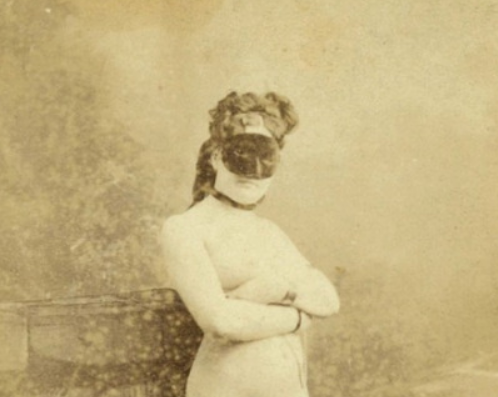
Sadiah Qureshi covers the obvi implications of this sort of virtual tourism: [Quote] Baartman [the famed and derogatorily-named Hottentot Venus, a Khoekhoe woman from South Africa] was exhibited in Piccadilly […] just three years after the abolition of the British [domestic] slave trade in 1807 […]. Foreigners were imported in much larger numbers following London’s Great Exhibition of 1851 […] [a] celebration […] [which] started a whole genre of display throughout Europe, America, India, Africa, and Australia. The fairs were designed to be visual encyclopedias, to entertain and educate visitors […]. [T]he 1886 […] [India and Colonial Exhibition] featured dozens of “living natives.” These foreign peoples worked in cafes, in a model diamond mines, or in demonstrations of Indian crafts. The fairs were such an attraction that attendance figures ran into the tens of millions. [End quote. Text by: Qureshi, "Exhibit B puts people on display for Edinburgh International Festival," 2014.]
Museum-as-theatre, a virtual reality, mediating colonial events and "new" "scientific" revelations for an anxious public.
---
But anyway, Dickens wouldn't have been alone in being a popular-in-his-time author adjacent to concerns of imperial frontiers. I'm also reminded of one of the more peculiar little tangents from Kathryn Yusoff on Edgar Allan Poe and popular fantasies having sway over substantial materiality, even before 1890s Yellow Peril fears of East Asian "alien" invasion.
She frames it like this:
[Quote] The origins of Wilkes’ US Exploring Expedition [in the late 1830s] stemmed from John Symmes’ petition for a US-led expedition to substantiate his Hollow Earth theory. […] To support a bid for funds for a southern expedition, the Secretary of the Navy employed Jeremiah N. Reynolds to collect information from the public as to what areas of the globe were most in need of exploration. Reynolds […] [was] a keen supporter of Symmes’ theory […]. Indeed, one of Reynolds lectures was attended by Henry Allan, the brother of Edgar Allan Poe. Poe was in turn inspired to write his only novel, The Narrative of Arthur Gordon Pym of Nantucket. It was in the context of Wilkes’ departure for Antarctica in 1837/38 that Poe published his novel in […] a first example of Science Fiction (SF). In exploration, narrative was a form of aesthetic instrumentation […] that acted as a […] lens onto the unknown or peculiar. […] Narrative is clearly part of the scientific apparatus – the ability to tell a good yarn, to excite, stimulate (and embellish, where appropriate) was part of the expectation and construction of scientific accounts. […] That Antarctica is often the site of inversions in understanding is not just a convenient literary trope of a far-away place, but is also based on the […] problems that the landscape posed to normative structures […].” [End quote. Text by: Yusoff, "Climates of sight," 2008.]
In other words, one of the US's formative "fantasy"-ish authors was being inspired by this stuff. Reports from the Antarctic expedition, which the US Navy was undertaking to appease public interest in a Hollow Earth theory, were being published among the public at the same time that Poe’s Antarctic story were being serialized in Harper’s, like a feedback loop.
So the popular fantasies (the "virtual" realities) acted like an instrument.
---
But there is also Yusoff's other implication: A place like Antarctica - and a creature like Megalosaurus - can be "problems that the landscape posed to normative structures." Among those normative structures: Linear progression of time.
Orientation (read: vulnerability) of the empire in both spatial and temporal dimensions. Hence all the Victorian-era Egyptomania; fixation on "antiquity"; leisure tours of Mediterranean/Hellenistic ruins; and what Ann Laura Stoler described as "imperialist nostalgia" for lamenting civilizational collapse and decay while visiting colonial ruins. "If Uruk and Nineveh could fall, if Thebes could and Mycenae could fall, if ROME could fall, then how could our civilization based in fair London survive such vast eons of time and such strong geological and environmental forces?"
(Francis Fukuyama scared of political implications of dinosaurs, mayhaps?????)
Martin J.S. Rudwick described a process of “the reconstruction of geohistory in the Age of Revolution,” wherein the political anxiety arising from rebellion in Haiti and other colonies was influential on European scientific cultures (Lowell's geology-as-discipline ascendant in same years following Haitian Revolution). Which finally brings to mind - you guessed it! - Pratik Chakrabarti. Discussing how the term "Gondwana," now used to invoke connotations of The Ancient and whatever, was elevated after Victorian scientists encountered new knowledge about agricultural-wealth-extraction potential and about depth of deep time while studying sediment in mid-nineteenth-century India, Chakrabarti has noted pointedly that this “imagined supercontinent has led to real landscapes,” as “its geological denominations have lent it racial and cultural significance and the term Gondwana is used to describe Afro-Asian cultures” since “primitivism was essential to nineteenth-century colonialism, in which the conquest of landscapes also entailed the conquest of their deep past”; ultimately, “the Gonds, their myths, forests, histories, their black soil, coal, all of which were at the same time being colonized, appeared pliable to alternative interpretations”. Or, like? The lives of people, the epistemological spectrum of cosmologies, the fates of landscapes, and "data" itself - about India, Antarctica, or dinosaurs/deep time - appeared pliable to alternative interpretations. Whatever idk.
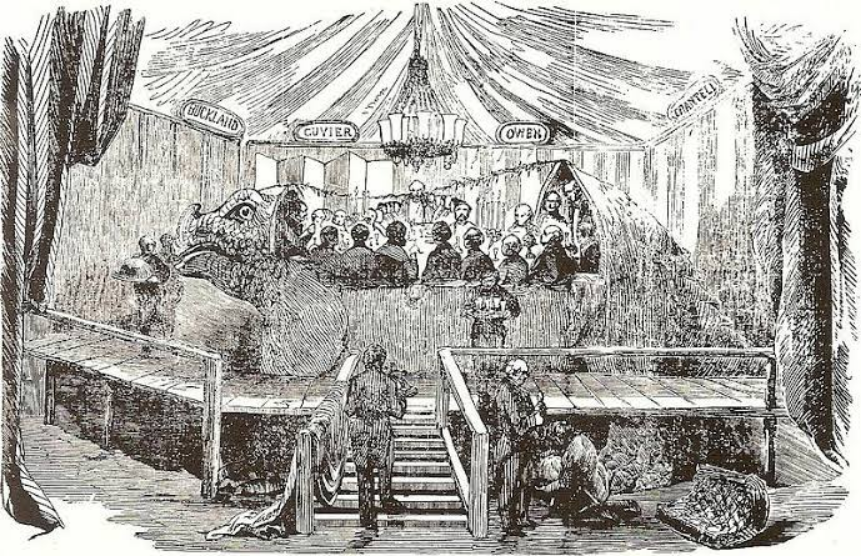
Have you ever seen illustrations of the New Year's Eve dinner party at Crystal Palaca (1853), when the party-goers were all served their drinks while they sat inside the Iguanodon model? Do you think they might've served Indian punch (literally consuming India while partying inside a dinosaur at a temple commemorating the triumph of modernity)?