The 'Great Beast' (a tapir), Early Modern commodification, and circulation of 'wondrous' knowledge about Latin American animals

(Originally posted elsewhere on 5 February 2024.)
Thinking about “the Great Beast”.
Thinking about the superlatively unique and loveable creature, the tapir.
Thinking about European colonial agents being perplexed and bedazzled upon first encountering the “forest cow” and the “elephant of the New World”.
Thinking about how an incredible extinct megafauna icon, the giant ground sloth, got its name (and became a central character in popular and professional discussions of paleontology and “extinction”).
Thinking about bulletproof moose.
Thinking about eighteenth-century apothecary remedies.
Thinking about how an animal name traveled from the Sahara in North Africa, through Arabic into Spain, to boreal forests of northern Eurasia, across the Caribbean and South America to describe “the beaste in which nature hath endeavoured to shewe her cunnyng”.
See here [excerpt]:
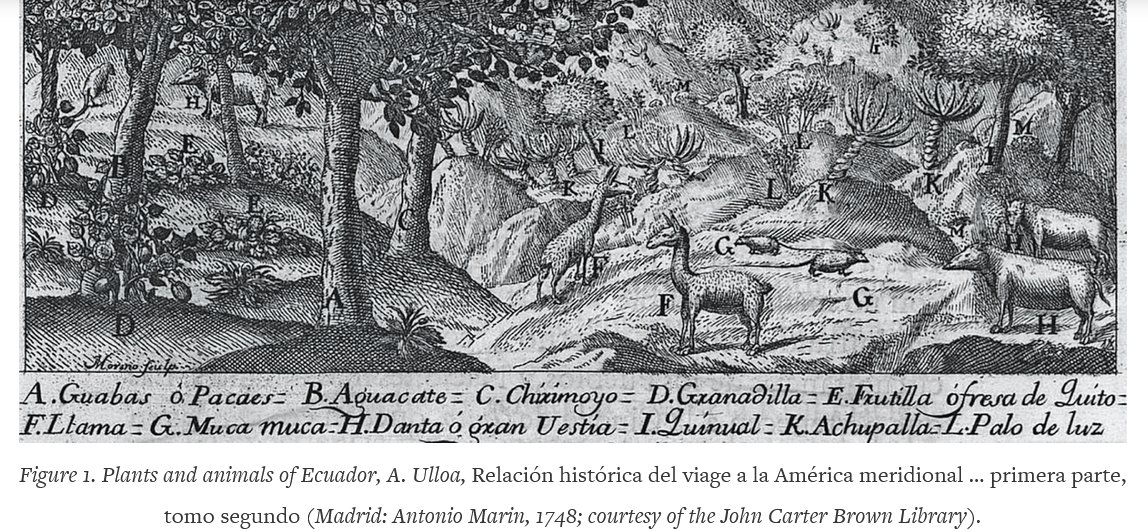
Tapir’ is a name taken from Tupi, the native lingua franca used in the Portuguese New World dominions. Today this name covers five extant species, including one from Malaya [and the other four from Central/South America]. Whereas the name ‘tapir’ was first used in manuscript and print in the second half of the 16th century, the Spaniards had seen and mentioned the animal that the Tupi word named before, comparing it with cows [...]; in such analogies it was called vaca (cow), vaca montes (forest cow), [...] vaca danta (danta cow), sachavaca (jungle cow) [...]. Apparently, it was first seen by Spanish navigators [...] on their expedition to [...] (Panama) from 1509. In 1514, [P.M.] [...], future chronicler of the Council of the Indies in Spain, described the strange animal in these terms:
But there is especially one beast engendered here, in which nature hath endeavoured to shewe her cunnyng. This beaste is as bygge as an oxe, armed with a long snoute lyke an Elephant, and yet no Elephant. Of the colour of an oxe and yet noo oxe. With the house of a horse, and yet noo horse. With eares also much lyke unto an Elephant, but no soo open nor soo much hangying downe, yet much wyder than thee eares of any other beaste. [...]
In 1526, the Spanish explorer of North America Lucas Vazque de Ayllon [...] first observed the American moose [...], calling it danta. In the same year, Fernandez de Oviedo in his 1526 Natural History of the Indies recorded what seems to be the first transfer of an Old World name to the tapir. Oviedo remarked that the Spaniards from Tierra Firme or mainland South America had been using ‘danta’ to refer to an animal that the natives called beori for the quality of its hide. ‘But they are not dantas’, Oviedo underlined. [...]
---
As early as the 1520s, Spaniards and Portuguese starting calling two New World animals - the moose of North America and the tropical tapir - anta, adanta or danta, which were names [originally] for the elk of the Old World.
In turn, that name had been the eventual result of a late medieval transfer of words and properties of African animals to rather distinct ones of Northern Europe. ‘Anta’ and the several versions of this word derived from the Arabic lamt or lamta, which denoted the oryx of the Sahara, a kind of ‘anta-lope’. Arab geographers referred to the large Berber tribe of the Lamta, who were particularly famous for the light and solid shields they made from an animal of that name. These prized hides were offered to the kings of the Maghreb and al-Andalus [part of which would become Spain].
The transfer of names, virtues and objects happened more than once and involved regions far beyond the Americas. Through a process that involved comparison, analogy and translation, the fauna and flora of the Americas were incorporated into a novel ordering of knowledge and representation [...]. In this order of words and things, large animals from different regions of the globe were subsumed under the name of the ‘great beast’, a source for a remedy against epilepsy. [...]
---
[Epilepsy] was one of the world’s most intriguing maladies. [...] Many animal and vegetal substances were reputed as anti-epileptic remedies. [...] Among the chief of them were [...] the foot of an elk [...], substances mentioned in nearly every early modern cabinet of curiosity or apothecary. [...] In Africa, [...] the names ‘the great beast’ and alce were used for the Congo animals that the Portuguese [...] and the locals [called] ncocco or neollo.
Before becoming a source of medicinal nails, elks had been highly valued for their skins. The Russians obtained them from the Siberian Khanty and Nentsy peoples, trading in hides with China.
The trade in elk skins from Russia and Livonia was in part managed by the Dutch, who transported them to Spain and Portugal, where anta [...] became the general name for the elk, the buffalo and all animals ‘which had an armour’ [...] used for crafting shields [...] and jackets for soldiers. Like the skins of rhinoceros, the African ncocco and the American tapir, oil-tanned elk skin was highly prized for clothing since it was considered bulletproof. [...] Feliz de Azara was still attributing this property to the Paraguayan tapir in the late 18th century, emphasizing that ‘the gun never succeeds in killing them’. Azara, apparently, was simply gathering the observations of [...] the 17th-century chronicle on Paraguay written by [...] Antonio Ruiz (1568-1652). [...]
Ruiz was [apparently] the first to attribute anti-epileptic virtues to the tapir [...]. Beginning in the 17th century, every time the tapir was described in no matter which region of South America, the medical virtues of its hoof reappeared. [...] Continuing into the 19th century, [...] in Guyana, the hoofs of a tapir were used [...] for snakebites, ray stings and fits [...]. Gumilla’s observations would be incoroporated into European remedy books [...]. Translated into Spanish in 1739, the collection of recipes incorporated the great beast twice: first, in the [...] recipe, where the ongle d’elan was translated as de la gran bestia, and second in Father Gumilla’s observations, where the gran bestia was defined as the anta of Venezuela. Similarly, in Spanish dictionaries from the late 18th century, the elk (or anta) is replaced by the tapir; anta became an animal from the Indies, whose left nail was known as una de la gran bestia. [...]
---
[T]he French anatomist Georges Cuvier (1769-1832) decided to compose the name megatherium (’great beast’ in Greek) for a skeleton of a ‘rare animal’ found in the environs of Buenos Aires and mounted as an almost complete skeleton in the Royal Cabinet of Natural History in Madrid [the world’s first paleontological reconstruction of an extinct vertebrate exhibited in a museum setting]. In doing so, Cuvier made the extinct mammal from South America the only and unequivocal ‘great beast’ [...]. Did he find inspiration in the report of the Spanish officer who, at the moment of discovery, described the fossil bones to be shipped to Spain? The draughtsman had compared the unknown animal not only with the elephant but also with the anta or gran bestia [tapir]. Buffon had called the tapir ‘the elephant of the New World’.
Now, with the new principles of Cuvierian comparative anatomy, there was no doubt that the greatest beast from South America had passed away long ago. Nevertheless, the beast continues to live in [this legacy of animal naming].
---
Text, image, and caption above by: Irina Podgorny, “TAPIR,” in New World Objects of Knowledge: A Cabinet of Curiosities, edited by Mark Thurner and Juan Pimentel (2021), pages 237-240. At: j stor dot org slash stable/j dot ctv1vbd275