The rise of the colonial image of 'man-eating tiger' and 'Himalayan sublime' as anxious British response to anticolonial/Indian agency: Nivedita Nath and Varun Sharma in conversation

(Originally posted elsewhere in December 2023.)
Varun Sharma on why the image of the man-eater in British popular fiction "shined most brightly" in a very specific moment of anxious transition between the heyday of empire and ascendant Indian nationalism as a way to yoke-out the understanding of Indian subjects as "hapless victims" and active agents.
And
Whither the man-eater? This entity was once the prime interest of an entire league of famous sportsmen in colonial India, the engrossing content of many books [...]. [T]he man-eater was first constructed, and then dismantled [...]. This erratic rise and fall of the man-eater is descriptive of changing power relations, the ephemeral yet pervasive axis between the colonial and the post-colonial [...].
---
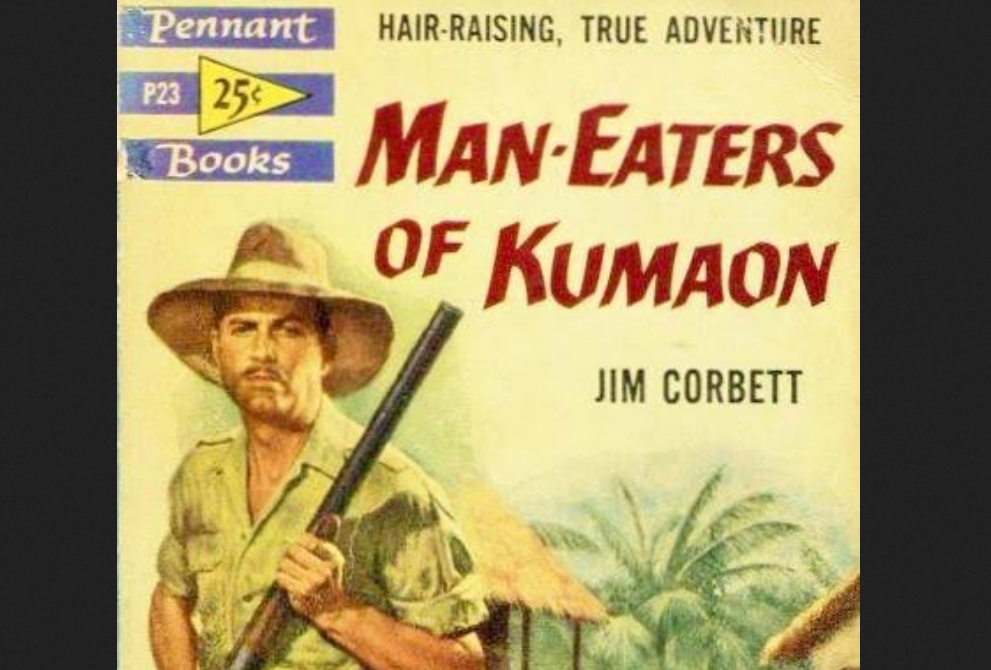
Jim Corbett was a case in point. [Around the time of independence, Corbett authored popular stories of his adventures in colonial India in the preceding decades, including Man-Eaters of Kumaon and The Man-Eating Leopard of Rudraprayag]. [...]
The man-eater was destined [...] to shine in all its ferocity at a certain moment in time and not any other.
Thus, [there is special] context within which specific 'meanings' get associated with animals, at certain times, and at the the hands of select actors [...].
[T]he engulfing realm of the printed word, especially the English book, gave astounding shape and clarity to the idea of a man-eater. [...] The man-eater was never thought of as a sub-species of Panthera tigris in the tables of natural history; rather the man-eater [...] was ‘out of nature’, and thus some kind of an addendum to naturalist understandings. [...] The making of the man-eater into a coherent animal category follows an arduous path. [...] [M]otor cars and other gadgets such as hunting lights had arrived on the scene. [...] [A British officer] who had served in the Central Provinces for quite a while after [1909] [...], commented [..] ‘With modern inventions it would be quite easy to be playing cards in the tent [,] and when the tiger turns up, kill him by pressing a button on a tent wall.’ [His] exasperation was evident [among] [...] [s]portsmen in the 1920s and 1930s [...]. [A] single species splits into undefeatable man-eaters and gentlemanly tigers worthy of observation alone. [...] Amid such lesser sportsmen the man-eater thus became a tactic of power which elevated its [colonial] victor over both the hunters of the past and contemporaries of the present. [...] But it is truly a question if this muzzle-loading gun in the hands of the native [...]. The implication was that sportsmen had a fairer sense of restrictions than the non-sporting classes. With the latter classes gaining political mobility, fears of an 1857-like massacre were also in the air. [...] [B]y the 1930s [...] a host of sportsmen [...] might have preferred to see natives handling a rickety muzzle-loader than an elegant express rifle; the man-eater was intended to remain at large for those ["superior" colonial sportsmen] in possession of the latter. [...]
---
This development of a sportsman into an author can be located within a history of the book. [...] The English novel as a genre [...] began to acquire greater circulation after [...] 1870. [...] [A] book on which the sportsman laboured was like a trophy [...]. For all such ongoing fuss about size [records], a man-eater was more about qualities: cunning, finesse, stealth [...]. If the difficulty of hunting a man-eater was what gave the sportsman a chance to prove the superiority of his skill [...], then this difficulty was the stuff of a story, not a [size] measurement or a mounted trophy. And [...] an aspect of photography. [...] It authenticated the effort of a sportsman and could not be bought of the market [taxidermy trophies available to simply purchase at local shops] except through a book that bore the author’s name. [...]
---
There were dimensions of imagination and power that accompanied this. The idea of a man-eater was such that it helped advance the long held belief that the natives were a hapless lot. [...] Pandian [...] shares how the man-eaters of the colonial period were equated with the ‘arbitrary monarchs’ of a pre-colonial era, which also the British sportsman as a symbol of ‘sovereign might’, would meet on its own grounds. [...] [Consider also] the manner in which the simultaneous depiction of the remaining tigers as ‘large hearted gentlem[e]n’ of the forests (a thing Corbett professed) went to convey the contrary image of a docile, tame and innocent nature that could come to be harmed by natives at the slightest instance.
Protecting the people gave the colonisers power over animals, and protecting animals gave it a power over people.
Notions of animality and criminality intersected at the site of the man-eater.
The entire continuum of man-animal relations was thus canvassed through this tactic, which also the medium of the book in the later colonial periods broadcasted to distant corners of the colony. [...] What perhaps distinguished the man-eater from any ordinary form of game hunting was that it was additionally a form of ‘language-game’. [...] [T]he man-eater was an account in which the ephemeral idea of an ‘India’ glimmered constantly in the background. But it did so largely in English. The man-eater was an English diatribe [...]. The side by side portrayal of the victims of the man-eater as ‘superstitious’, ‘rural’ and ‘ignorant’, only went to establish before the (civilised) readers the proof of an (uncivilised) mass waiting to be salvaged, assimilated or disciplined. [...] [A] mild perusal of Corbett’s My India, published about five years after India’s gaining of Independence, provides ample evidence of the above dynamic. The eventual autonomy of the British administration besides a celebration of the decision making capacities of rural masses (described as ‘real’ Indians) is legend in the pages of this book. The political reality of colonial rule is conflated with a nationalistic pride, which also the sportsman allocates to himself in the describing of his (my?) India. One is left to understand that the man-eater thrived at its best in a colonised India as much as an Indianised colony. As the tension between an emerging nation and an erstwhile colony acquired sharpness in the later colonial periods and a decade thereafter, the narrative of the man-eater came into its own.
The man-eater is thus a veritable creature of timing that shone at its brightest in the 1940s, even if it had been shot down 30 years ago by the likes of Corbett. [...] [Later in the twentieth century, there was a] transformation of the landscape from a designated ‘wasteland’ under colonial administration to a ‘World Heritage Site’ in Independent India. At the peak of such transitions in the 1970s [...], the tiger itself was assuming cosmopolitan proportions and being regarded as a ‘citizen’ by the state. [...] [This was an] emergence of [...] a 'cosmopolitan tiger' [...].
---
All text above by: Varun Sharma. "Rise and Fall of the 'Man-eater': The Changing Science and Technology of a Species (1860-present)". History and Sociology of South Asia Volume 10 (2016), Issue 1. First published online 8 December 2015. [Emphasis mine.]
--
Excerpt 2:
The [British] annexation of Kumaun and Garwhal [in the "Indian" Himalayas, after 1816] [...] not only heralded new systems of revenue, land ownership, and forestry but also gave rise to novel aesthetic forms of valuing "nature." [...] [S]portsmen like Colonel Fred Markham declared that [...] hunting musk deer [...] and blue sheep [...] in the Himalayas could not be rendered into prose as dramatically as tiger hunting in the plains. Thus, in the mountains colonial writers relied upon the aesthetics of the sublime [...]. [M]usk deer and bharal hunting on the slopes of the Gangotri glacier […] had become a "set-piece" in hunting journals […] by the middle of the nineteenth century. English travelers to the Himalayas considered themselves unique in their inclination to "wander through strange lands for the mere purpose of seeing the country [...]," a trait that was ostensibly beyond the comprehension of "natives". Colonial travelers acknowledged the hill dwellers' love of home but dismissed them for taking "little interest in scenery which threw us into raptures." [...]
The life and legend of Frederick Wilson (1816-83) [...] reflects the ways in which the "psychological sublime" as it unfolded in the Himalayas was tied to colonial constructions of racial difference. To metropolitan readers and gentlemen sportsmen, Wilson was a self-trained natural historian, a paternalistic employer of natives, and a connoisseur of the wild. [...] He was a guide to famed hunters such as Fred Markham and Robert Dunlop. [...] Wilson's writings reduced paharis from perceiving subjects into unseemly objects of dirt: "Like the inhabitants of most cold, mountainous, and half civilized countries, the Puharies are extremely dirty; dirty in their persons, in their clothes, their cooking, their dwellings, and, in fact, in everything." [...] Although historians have located the major break in systems of land use [in the British-controlled Himalayas] [...] in the advent of scientific forestry in the last quarter of the nineteenth century, [...] new forms of economic exploitation [and racialization, and environmental management philosophies, had already been present earlier] [...]. Wilson's pursuit of hunting as a profession was exceptional among nineteenth-century sportsmen in the subcontinent. To monopolize trade in Himalayan musk pods (the gland of the musk deer) and pheasant hides, he relied on [...] contracts with the subordinated princely ruler [...]. "Shikari Wilson-Hunter and Lumberer" exported bear grease, monal pheasant feather, taxidermied birds, and musk before extracting wood from the forests of the Bhagirathi Valley in the 1860s to furnish the expansion of imperial railway networks. [...] The success of his enterprises relied upon "native" labor and knowledge [...].
---
[Initially,] animals and forest produce [had] effectively remained common property. [But] [a]fter he obtained a contract for the animal trade at a nominal rent from the Tehri Raja Bhawani Shah, who ruled under the paramount authority of the [British] colonial state, Wilson proved able to exploit this [...]. His ability to monopolize the hide trade suggests how the context of colonial domination reshaped the ecology of Garhwal even before the advent of scientific forestry [a particular style of British forest management for the purpose of long-term profit from timber extraction, implemented in the later decades of the century]. Wilson relied upon [...] "lower" caste shikaris and bajgis trained as taxidermists, centralized "bird godowns" for the collection and processing of skins and hides, and a commission agent dispatching time-sensitive orders to distant markets. He managed to dominate the taxidermy trade [...] with the use of arsenical soap as a preservative. A single season could yield "upwards of 500 birds, principally pheasants and partridges," "scores of the deer tribe," enough bears to furnish "upwards of a hundred quart bottles of grease," and four leopards. Musk and monal were his chief products before he successfully petitioned the raja of Tehri for the lease of the Bhagirathi forests in 1858. [...]
---
Wilson dispatched [these animal products] [...] to the imperial metropole [London, etc.] and Himalayan hill stations [where British administrators lived] in unprecedented quantities. We might consider Wilson's role in expanding the trade in monal hides and feathers as an example. The monal pheasant was little known in Britain before the latter half of the eighteenth century, when it was first coveted by East India Company officials. Lady Impey, wife of the the chief justice of Bengal, first housed a monal in her extensive menagerie. The pheasant was subsequently named Lophophorus impeyanus in her honor. With the expansion of the monal trade, the high-ranking colonial official's fascination with this once rare and exotic emblem of oriental riches spread to the metropolitan public. Toward the latter half of the nineteenth century, monals were used to ornament women's bonnets and serve as ornithological specimens. Metropolitan ornithologists [...] singled out Wilson's taxidermied pheasants as objects of praises, creating a demand for them in the process. Over his thirty-year career, Wilson sent an average of fifteen hundred monal skins to Britain yearly. [...]
---
Wilson continued to curate the Himalayan sublime for European sportsmen well into the 1860s. [...] However, by the 1870s, the scale of Wilson's extractive enterprises in the Bhagirathi Valley was gaining notoriety. Writing in Hume's Stray Feathers, Edwin Brooks admonished the wreckage left behind by Wilson's logging operations, writing that "such wanton and wholesale destruction of the timber of a fine valley is not to be met anywhere else upon the face of the earth." Though Wilson defended himself against Brooks by arguing that the destruction of "grand old forests" was a "sad necessity," his lease over the Bhagarathi forests ultimately transferred to the Forest Department. While the advent of scientific forestry in the Central Himalayas heralded a new discourse about the management of nature [still in service of extraction and profit], the demarcation of racial difference remained central to the colonial imagination of Himalayan peoples and places.
---
All text above by: Nivedita Nath. "Imperial Hunting and the Sublime: Race, Caste, and Aesthetics in the Central Himalayas". Environmental History 26 (2021): 301-323. doi: 10.1093/envhis/emaa084. [Emphasis mine.]