Unexpected qualities of socializing and violence in New Orleans?: Reviewing Cecile Vidal's historiographical interventions in Caribbean New Orleans: Empire, Race, and the Making of a Slave Society

(Originally posted elsewhere on 4 February 2024.)
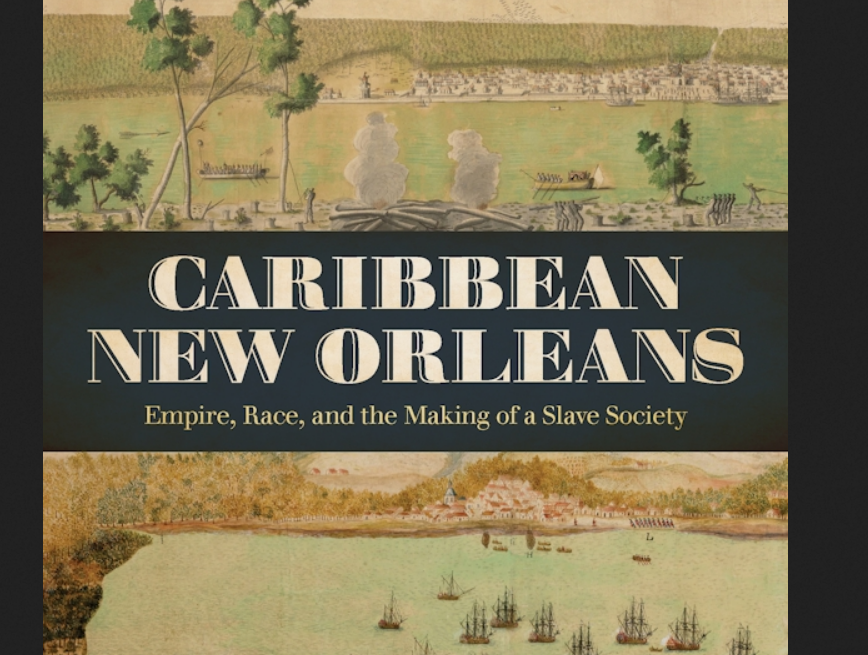
At H-Net, was reading Kristin Lee's review of Cecile Vidal's new Caribbean New Orleans: Empire, Race, and the Making of a Slave Society (UNC Press, 2019).
Fun takeaways:
Though US-administered Louisiana from circa 1805-ish to 1865 was (what has been characterized and argued/counter-argued as) a slave society (in which the chattel slavery institution was central feature), earlier French New Orleans was also (in Vidal's interpretation?) fundamentally a slave society BUT in its own distinct ways that require more academic attention.
This is despite French Louisiana's reputation (relative to later US Louisiana) as more cosmopolitan in its allowance of the blurring of racial/social boundaries.
Given today's Cancer Alley toxicity, fossil fuel pipelines, "critical infrastructure" laws, mass imprisonment, etc., we could maybe see 300+ years of violent racial hierarchy BUT which wears distinct masks at different times. Different formations.
It's important not to subsume French Louisiana into mere analogue of antebellum US Louisiana.
Another thing that I like about Vidal's framing is her attention to the legacy of the 1729 conflict between the Natchez people and Louisiana authorities. Here, Vidal argues that the spectre of Indigenous defiance helped entrench boundary-maintinence: a "pivotal moment in the militarization of white New Orleans."
Anyway: Among the other big interventions of Vidal here is taking more seriously the interpretation that New Orleans functioned as a very "Caribbean society," and "northernmost port of the Caribbean." Here, she invokes Haiti (and shows the transference of Haitian planters/their money to New Orleans following outbreak of revolution). This, of course, appeals to me (geography, global circulations/connectivity, trans-imperial boundaries, Caribbean-as-laboratory, blah blah blah, you know my tastes by now).
Vidal looks at a loooot of archives.
But I'll let Lee describe it.
--
Excerpt:
Vidal [...] emphasizes the close relationship that existed between the Louisiana settlement [at New Orleans] and the Caribbean island [Haiti, the colony of Saint-Domingue] during the former’s French colonial period (1718-69). It has become a bit of a popular adage to describe New Orleans as the northernmost port of the Caribbean, but Vidal’s Caribbean New Orleans: Empire, Race, and the Making of a Slave Society demonstrates the substance behind these claims. [...] New Orleans is the missing link, a late-forming city that largely inherited its founding ideas, practices, peoples, plants, and laws from its longer-established imperial neighbors [France, Spain, Britain, and what would become the United States]. It thus offers the ideal case study in which to consider how colonies around the Americas developed in conversation with one another [...].
Vidal convincingly argues that New Orleans was a “slave society,” or a settlement in which racialized slavery informed every part of everyday life from its inception, whose physical construction was done alongside the “construction of racial categories” (p. 1).
This is an important shift within Louisiana historiography, which has long stood by [...] [the] argument that early New Orleans offered the semi-unique example of a “slave society” devolving into a “society with slaves.” Abandoned by the French following the spectacular failure of the Compagnie des Indes, the standard story goes, New Orleans became an isolated backwater until the 1770s, struggling to survive and permitting, out of sheer need, less disciplined contact between residents of European, Indigenous, and African birth and descent. [But] Vidal, in contrast, shows that, while Louisiana struggled to create a full-fledged plantation economy during the French era, this did not prevent its capital from organizing itself along the highly stratified lines of the Caribbean islands.
---
Furthermore, she argues, because New Orleans did not see many new residents after 1731, free or enslaved, and because it was a smaller settlement, white inhabitants were able to build upon these ideas in a relatively stable environment - focusing much of their energies on surveilling, containing, and disciplining the enslaved and free persons of color (p. 26). [...]
Vidal especially points to the 1729 Natchez attack and ensuing Natchez Wars [against Indigenous peoples] as pivotal moments in the militarization of white New Orleanians [...].
Subsequently, a scrupulous supervision of racial boundaries became the norm for the rest of the French era and fostered “a sense of community among white urbanites” (p. 141). Chapter 3 takes readers to the streets, levees, and other public spaces of New Orleans, where whites sought to sculpt the privileges of “whiteness” against both residents of African birth and descent as well as one another. Elite men and their wives scuffled over the best seating at church in an effort to recreate France’s ancien régime culture; socially lower [...] nonslaveholders, meanwhile, carefully guarded their weaker claims at mastery through street violence [...]. Beginning with a careful reading of census categories, Vidal traces how distinctions between European settlers [...] were increasingly replaced with those centered exclusively on race by 1763. [...] [Vidal then] follows the ways in which the demographically diverse workforce of the early colony made up of white indentured servants, convicts, and soldiers in addition to enslaved Africans - gave way to associations of difficult and degrading labor limitedly with the enslaved. [...]
---
French Louisiana inherited racial categories from the Caribbean but adjusted them to fit local needs, experiencing “not so much a loosening, but a more complex transformation” of its racial regime, largely through violence (p. 371).
Vidal documents how the Superior Council utilized targeted prosecutions and punishments to increasingly “imprint terror and instill obedience” on the enslaved (p. 390). [...] [The book] thus details a society in which racial hierarchies were asserted and supported through both top-down and bottom-up policies and practices, as “no social institution or relationship was left untouched by race” (p. 504).
To this end, Vidal speaks to important conversations by historians of enslaved women in the British Caribbean, including Jennifer Morgan and Marissa Fuentes. These authors have used a similarly wide range of sources [...] [and] archives to underscore the invasive nature of colonial racism. [...] [I]n part [...] Vidal’s [chapters work] to decouple lower Louisiana history from the fur traders of New France [Ontario, Quebec, and the watershed of the Mississippi River] and to reattach it to the planters of Saint-Domingue [in Haiti and the Caribbean]. [...] Combing through administrative papers, censuses, laws, parish registers, correspondence, and judicial records from both sides of the Atlantic, readers will get a sense that there is little Cécile Vidal has not seen or considered. [...] Her book [...] hopefully will convince an even wider audience [...] [to engage with] comparative, cis-Atlantic, and transatlantic studies of imperialism, race, and slavery.
---
All text above by: Kristin C. Lee. "Review of Vidal, Cécile, Caribbean New Orleans: Empire, Race, and the Making of a Slave Society". H-Atlantic, H-Net Reviews. January 2022. URL at: h-net dot org/reviews/showrev.php?id=56913 [Emphasis mine.]