Urban ruination, "master narratives of history," and counter-memories from those 'banished to the periphery': Tim Edensor's work (for Halloween!)

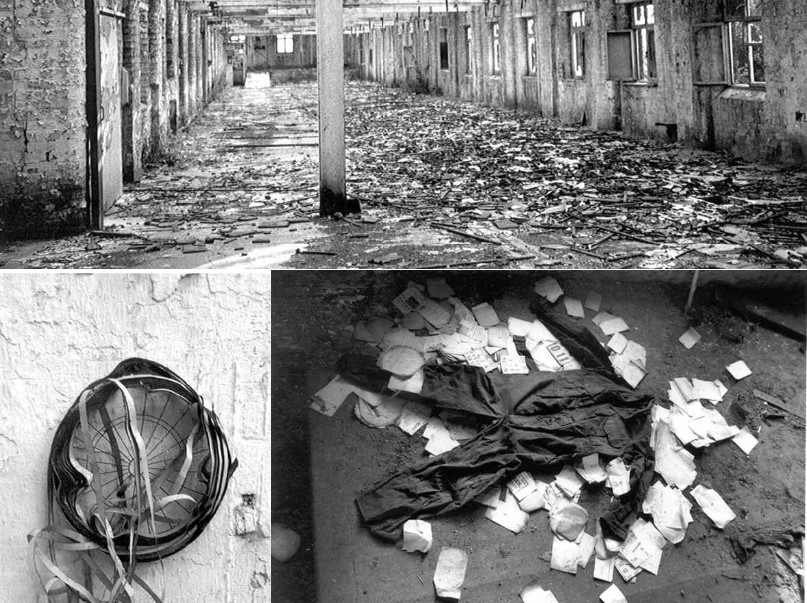
(Originally posted elsewhere on 30 October 2023.)
Two excerpts.
Fun. Like a ghost (on-brand for Halloween), I’ll keep my voice to myself (or… wait, by presenting them as such, with selective excerpts, is my voice quite present if only more subtle through editorial choices? Very ghostly).
—
Excerpt 1:
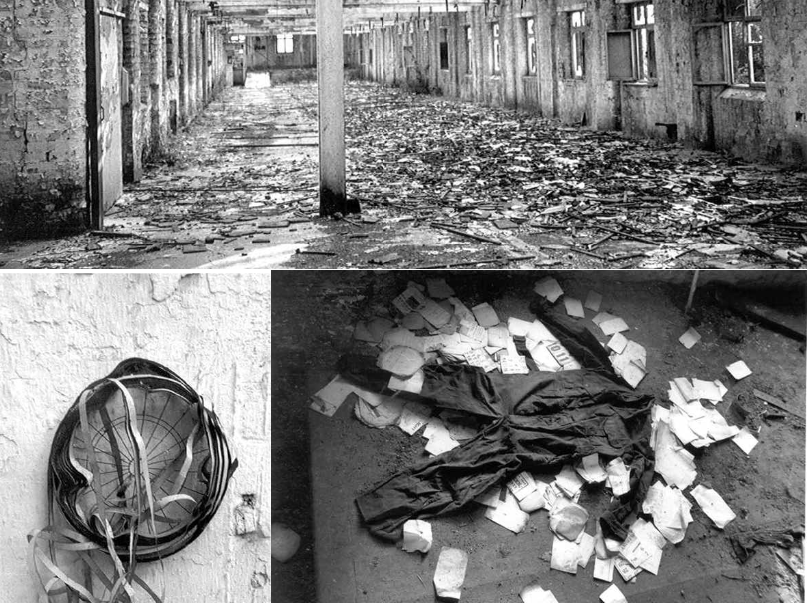
In the ruins, ‘master narratives of history as progress decompose into the tense confabulations of a continuously remembered past that hits the present like a nervous shock’ [...]. The ghosts of this past rear up in the ruin, they are the debris of unprecedented material destruction [...] ‘the “trash” of history’ [...]. Forgetting this carnage [would be to support] the myth of [...] progress [...]. But the ruins remember [...], revealing the fragility of the social order. [...] Hauntings rupture linear temporality, inconveniently bring forth energies, which have supposedly been extinguished and forgotten. [...] Cities [and places, generally] seem to becoming increasingly regulated. In the transformation towards a service economy during the 1980s [in Britain], [...] [o]ld industrial sites were turned into shopping centres, retails parks and leisure sites. [...] There is then, in the drive to market places, [...] an aesthetic imperative to smooth over the cracks [...], and to fix the past, so that it does not intrude into an imagined linear future. [...] In cahoots with [...] marketeers, they suggest that the past is a distant, romantic echo that resounds faintly in museums [...]. Yet the ruins shout back at the refurbished urban text. [...] [T]hey haunt the city, for the unofficial past cannot be exorcised [...]. Ruins are sites where we can construct alternative stories to decentre commodified, official [...] descriptions, and [...] keep the past opened [...]. Counter-memories can be articulated in ruins, narratives that talk back to the smoothing over of difference. Away from the commercial and bureaucratic spaces of the city, ghosts proliferate where order diminishes. Ruins are [...] especially important, because [...] it is ‘essential to see the things and the people who are primarily unseen and banished to the periphery of our social graciousness.’
Text and images above by: Tim Edensor, “Haunting in the ruins: matter and immateriality.” Space and Culture, vol. 11 (January 2002), pages 42-50. [Emphasis mine.]
-
-
-
[T]he contemporary Western city [...] [is] the site of [...] regulatory regimes concerned with strategies of surveillance and aesthetic monitoring [...]. The modern city can never become a wholly Appollonian, seamlessly regulated realm for it continues to be haunted by the neglected, the disposed of, and the repressed [...]. Within the interstices of the city there are a host of other spaces, part of a “wild zone”, a “[…] site […] which avoids the objective processes of ordered territorialisation […]”.
Staged […] through the intensified mediatisation and commodification of popular sites, myths, and icons […], mediated imaginary geographies circulate through adverts, soap operas, ‘classic’ rock stations [...] typically drenched in […] ideologies. […] These exhibitions memorialise culture via ‘publicly sanctioned narratives’ and institutionalised rhetoric [...]. [I]n which people are encoded and contextualied, categorised and narrated.
Accordingly, ruins are places from which other memories can be articulated [...]. [T]he outmoded object can become charged [...] with a certain power, and “might spark a brief profane illumination of a past productive mode, social formation, and structure of feeling - an uncanny return of a historically repressed moment” [...]. Thus we might stumble across seemingly archaic decor or furniture, [...] toys, and mascots of yesteryear [...], the debris of discarded fashions [...]. Although such objects [may] seem [...] absurd or comical, they may bring back knowledge, tastes, and sensations [...]. This was debris which was enfolded into the mundaneity of a shared everyday [...].
Along with other places on the margins of regulated space, industrial ruins are “points of transition, passages [...], moments of magic that exist at the interstices of modernity” […]. Modern attempts to cleanse, banish ambiguity, and order the memory of space are always disturbed by such disorderly spaces and by the ghosts they contain, who refuse to rest quietly, [...] a “spectral [...] residue“ which haunts dominant ways of seeing and being [...].
In contradistinction to the fixed memories [...] and to the imaginary linearities proposed by hegemonic […] memories, these ghosts foreground ambiguity, polysemy, and multiplicity, enabling us to “disrupt the signifying chains of legitimacy [...].” Although it is often overcoded and regulated, the city nevertheless contains multitudinous scraps from which alternative stories might be assembled. […] In spaces such as industrial ruins, the excessive debris confronted constitutes material for multiple modes of narration about the past: “the debris of shipwrecked histories still today raise up the ruins of an unknown, strange city. They burst forth within the modernist, massive, homogenous city like slips of the tongue from an unknown, perhaps unconscious, language” [...].
This kind of remembering implies an ethics about confronting and understanding otherness (here, the alterity of the past) which is tactile, imaginative […].
---
Text above by: Tim Edensor, “The ghosts of industrial ruins: ordering and disordering memory in excessive space,” Environment and Planning D: Society and Space, vol. 23 (2005), pages 829-849.