'When the mayor arrives, send him to Hell for me': Sex workers' radical newspapers, race, and Cuban nationalism in Tiffiany Sippial's text

(Originally posted elsewhere on 11 June 2026.)
So there’s a lot going on in this single chapter of Sippial’s. There’s something I left unrepresented in this excerpt, because I want more time to mull it over. I’ll include those thoughts as preface.
So the relatively “radical” newspaper here--purportedly edited/compiled by activist sex workers with primary objective of advocating on behalf of sex workers against state harassment—seems pretty cool in this excerpt, right? The poetry/ballads are nice.
But something else going on is discussed at length across the entirety of Sippial’s full book: Both activist sex workers and various functionaries/boosters of the state—and many in-between—couched their arguments/appeals (for regulation, non-regulation, reform, criminalization, etc.) in “liberal nationalist” appeals to “modernization,” “citizenship,” and “legitimacy.” In other words: Consistent with discourses at that time in Havana (on cusp of independence from Spain, contemplating optics to outside observers, and positioning the social body to adopt “republican” zeal).
A big caveat/context-clarity thing: Sippial proposes that the “white arisoocracy” of sex workers running the paper (registered workers, as opposed to unregistered “street walkers”) dismissed and strongly criticized “clandestine” sex workers who refused to submit to the permit department system.
Furthermore, the contributors/editors of the journal also apparently did not like what we would today call transgender women. Sippial includes the verbatim text of a really interesting—though hurtful and explicit—editorial in the paper published under the title “The Faggots,” where the author’s argument is basically: “They’re unnatural and gross and un-republican/un-civilized, BUT we love them as servants in our houses because they’re good at housework.”
Another big thing going on in this chapter is race—of course—and specifically the demonization of Chinese women as vectors of vice at that same time, since blaming “moral degeneracy” on Chinese women helped to refine an image of “modern” Cuba by displacing vice onto “external” or “alien” influences (read: migrants).
In the preceding chapter, Sippial gives more attention to Blackness and Black women, and how Cuban elite (particularly administrators and medical doctors involved in hygiene policy) framed Black women as fundamentally beholden to “African primal ways” (in a way, kind of like again externalizing the source of vice in a way that absolved “the Cuban soul/nation”). Newspapers (and members of the public contributing letters to the editor) also reflect distrust of Black men/women generally as sources of vice by nature of block parties and dances (wherein young white women were enchanted by—too innocent to know better and attracted to the music--mixed-race social events).
Anyway, the excerpt that I first sequestered happened to not necessarily address the aforementioned stuff. Instead, this excerpt features sex workers using their newspaper as a way to shit-talk the mayor with colorful, fun, dynamic forms.
—
Excerpt:
In 1888, former medical hygienist for Havana’s Special Hygiene Section Dr. Benjamin de Cespedes published the first large-scale study of prostitution in the capital city. The several-hundred-page tome [...] was an explication of [...] prostitution [...] and its effect on Cuban national identity. [...] [It] quickly became a best seller [...]. By the summer of 1888, bookshelves and newspaper stands throughout the capital city were filled with copies [...]. [De] Cespedes placed the burden of Cuba’s perceived moral decline on the shoulders of Cubans of African descent, stating that “in the lymphatic organism of Cuban society the suppurating abscess of prostitution is located in the customs of the colored race.” [...]
Now loosed from the bonds of slavery, de Cespedes argued, the Afro-Cuban woman spent her days moving surreptitiously through the capital city’s streets motivated only by personal profit. Left unchecked by colonial powers, this harbinger of destruction could “replicate herself like a population of microbes in a rotten maceration.” In a final Darwinian flourish, however, de Cespedes assured his readers of the ultimate victory of nature over [...] inferior life forms. As nothing more than “propagators of a terrible moral epidemic,” Afro-Cuban prostitutes were destined for extinction and eventual replacement by individuals with “more vigorous constitutions.” [...]
---
The most fascinating response to de Cespedes’s work emerged from the least expected source. On the morning of 30 September 1888, Sr. Manuel Betancourt, municipal judge of the Cerro District, received the fourth issue of La Cebolla, a small newspaper dedicated to the plight of Havana’s prostitutes. [...] [H]is response was swift. [He had the editor arrested.] [...] Each week the newspaper began with a forceful editorial that denounced the colonial authorities as abusive and corrupt [...]. Purposeful and incendiary, these opening pieces sought to educate the readership on its rights and motivate them to take direct--even violent--action in their own defense. [...]
[C]ontributor Teresa Machete stated:
The moment has arrived when we will no longer tolerate with our silence the unjust fines imposed upon as, at times because we refuse to submit to the lecherous whims of cops, and other times, because we don’t hand over the money they ask us for ... Today we won’t grin and bear it ... putting a stop to the ferocious instincts of our executioners. ... Whenever someone tries to run you down, here you have at your disposal the columns of this newspaper to voice your complaints, with the security of knowing that you will be defended with energy, with the same energy with which our exploiters will be combated. [...]
---
La Choro described La Madrilena [...] as a generous spirit whose political consciousness was forged in the tobacco factories of Andalucia and Madrid. Committed to the overthrow of “all forms of tyranny ... exploitation, abuse, or despotism,” she had initiated the uprising of prostitutes and proven herself willing to “throw herself before authorities, demanding justice.” [...]
[E]ven greater effort was expended detailing the abuses of enemies; namely, the municipal mayor (Conde de Ibanez) and his district police officers. [...] [T]hese men were regarded as government corruption incarnate by Havana’s prostitutes. The municipal mayor [...] was held primarily responsible for the unjust nature of the prostitution legislation. Local beat cops were considered nothing more than heartless lackeys who wielded the law to their own benefit. [...] By lampooning these men in poems and stories, contributors to La Bebolla tapped a common pool of experience and resentment among prostitutes and gave a specific face to the specter of the corrupt, abusive colonial official. The poetry submitted by La Cebolla’s contributors served as a textual forum for the public derision and denunciation of the mayor of Havana and his police force. Bearing titles such as “Soleares” and “Peteneras”--both references to Andalusian folk songs--these poems [...] communicate deep anger [...]. In a poem attributed to Lola la Sevillana, the author condemns the systematic exploitation of prostitutes:
I entered the cemetery And told the gravedigger That when the Mayor arrives Send him to hell for me.
A furious she-wolf Pulled out your entrails When you ordered them to fine me [...]
Girls, get inside Here comes the Inspector [...]
The cop doesn’t say anything If you hand him a coin. [...]
---
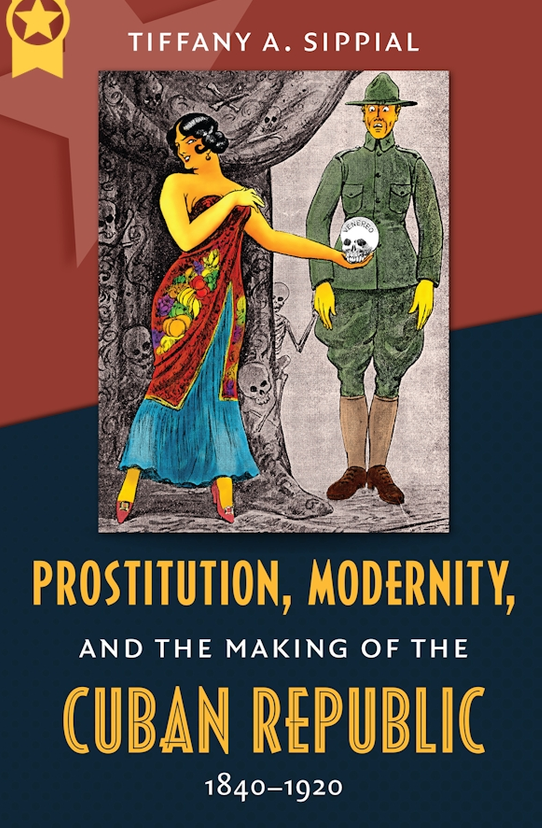
All text above by: Tiffany A. Sippial, Prostitution, Modernity, and the Making of the Cuban Republic, 1840-1920 (The University of North Carolina Press, 2013).