'Faking' Niagara Falls and the electrification of 'white womanhood' in Los Angeles, 1930s: 'Colonial spectacle' and electrical power in a modern(ist) nation

(Niagara piece originally analyzed in a post elsewhere on 7 December 2020. Los Angeles piece analyzed in a post elsewhere on 29 December 2021. Synthesized later.)
Two pieces from the past year or so—one in Environment and Society Portal’s Arcadia and one in Edge Effects. One on “visual histories” of the image of Niagara and ascent of electricity/hydropower. The other on the aesthetics of electrical infrastructure in Los Angeles in the same period. Thought they worked well when considered together.
Each piece implicates the themes of “artificiality” and “spectacle” in periods of national(ist) self-identity construction; infrastructure reflecting this simultaneous technological and aesthetic advancement; public monuments; publicity/celebrity; domesticity; imagined/romantic utopias.
Daniel Macfarlane—looking at the Niagara power projects developed from 1900 onward and eventually inaugurated in a major power plant in 1961—notes that the use of aerial visual perspective in physical models for planning was a curious new development among “North American governments” at the time of Niagara’s planning in the 1940s/1950s; he also acknowledges how “notorious” Robert Moses of New York City infamy was brought in to design PASNY’s Niagara' power project, while twentieth-century dispossession of the Haudenosaunee peoples and the toxicity of Love Canal were precipitated by the power project.
Sarah Kanous—looking at the Boulder Power Inaugural of the mid-1930s—describes a similar process. Instead of Niagara’s waterfall producing electrical power, the case of Los Angeles involves the production of electricity from newly-constructed Hoover Dam. Kanouse focuses more on the rise of “electrical metaphors” in nineteenth- and early twentieth-century rhetoric.
Advertising narratives, invocation of a “technological sublime,” and appeals to race/nationalism are at play in both scholars’ framings of these stories. While
—
Excerpt 1 (all text, photos, and captions by Macfarlane and appear here unaltered):
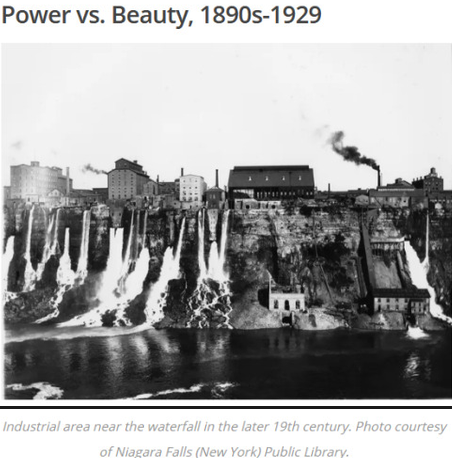
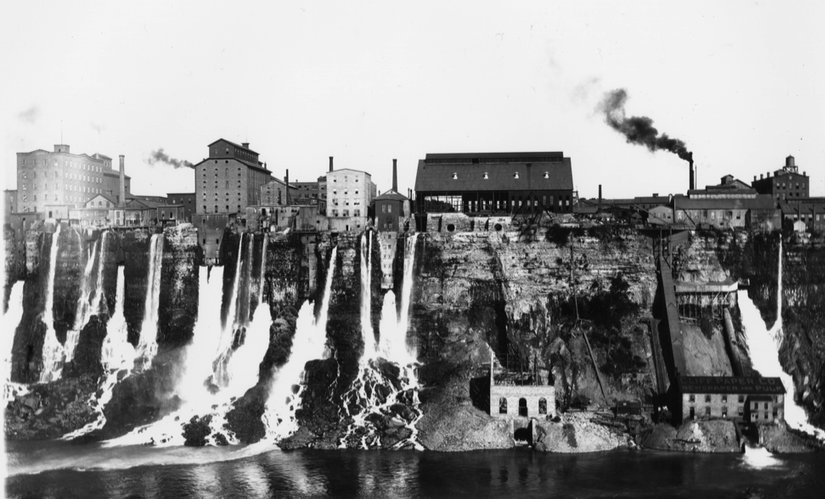
Niagara Falls is often held up as the epitome of the natural sublime. However, the visual appearance of Niagara today is the result of over a century of human manipulations. This essay is a visual documentation of the contradictory history of remaking the Niagara waterscape for both energy and beauty […]. Instead of barrels, honeymooners, and the carnivalesque, you’ll see hydraulic models, toxic waste, and Indigenous land appropriations. […] The industry concentrated here first used hydraulic power, then hydropower. This type of visual scene understandably marred the view for tourists, inspiring a preservation movement that “naturalized” the area depicted above and turned it into part of the Niagara Reservation. […] [S]ince these early generating stations barely tapped the waterfall’s power potential, Niagara was seen as a revolutionary site of energy, conducive to many imagined utopias. […]
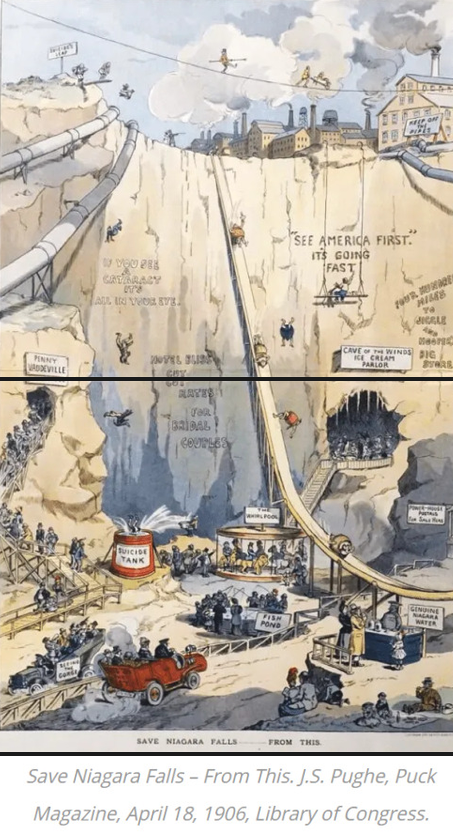
This cartoon satires the widely shared fin-de-siecle view that Niagara Falls would be most beautiful and impressive if it was completely diverted for electricity production. This effectively captures the industry vs. tourism – or power vs. beauty – tension. […] In 1929, the United States and Canada signed an international convention to increase diversions and remake Niagara Falls. It was, however, unable to pass the US Senate. A similar 1941 executive agreement between the two nations met the same fate. […] In response to complaints that people got too wet at the Falls, technocrats also intended their physical alterations to tame the mist and spray patterns. […] Both countries employed models to plan the physical rejigging of the waterfall. This privileging of models was a relatively new development for North American governments, and epitomized the high modernist outlook of expert planners. Engineers used the iterative “cut and try” method […]. To build its anticipated new Niagara Power Project, PASNY hired notorious New York City planner Robert Moses. The […] the footprint of PASNY’s new power station, named after Moses, which was the largest hydropower complex in the western world when it opened in 1961. […]
Over several years of bullying, intimidation, and legal legerdemain, the colonial apparatus was mobilized against the Haudenosaunee here. The case rose all the way to the Supreme Court, which ruled against their claims. All this was the rather predictable extension of several centuries of settler societies stealing Indigenous land. […] The toxic terror of Love Canal, a postwar suburb of the city of Niagara Falls, NY, is often presented as the opposite of the beauty of Niagara Falls, an aberration in its history. But […] the legions of toxins and nuclear waste buried here were the result of industries that set up shop at Niagara precisely because of its cheap electricity (not to mention that the Love Canal tragedy involved an abandoned power canal). Niagara Country is still pockmarked by toxic waste.
All text, photos, and captions above by: Daniel Macfarlane. “Faking Niagara Falls, A Visual History.” Edge Effects. 24 November 2020.
—
Excerpt 2:
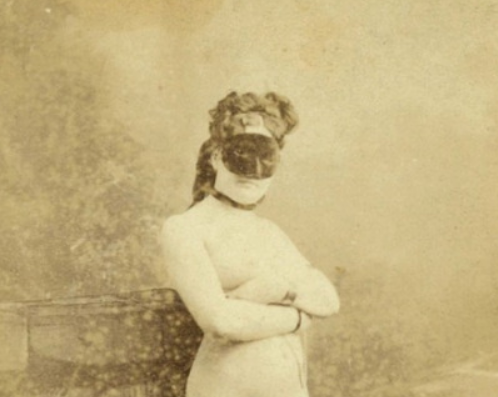
On 9 October 1936, Elizabeth Scattergood ignited a 60-foot (18-meter) electric arc over the Los Angeles Civic Center with hydroelectricity from the just-completed Boulder (now Hoover) Dam. Introduced as “the American Girl who possesses the potentially most powerful fingertip the world has ever known,” 28-year-old Elizabeth stood before the crowd of one million observers largely due to the role her father, Ezra Frederick Scattergood, played in the dam’s construction. Her presence literalized Ezra Scattergood’s future reputation as “The Father of Modern Power” and marked the first in a series of ceremonial performances anchoring the dam in very traditional narratives about gender, race, and nature. […] Picking up on the “Power Giants” metaphor, an account in the Los Angeles Times personifies electricity as a god-like and virile male figure with “meteor eyes flashing and lightning blazing around his head” whose entrance into the “dim-lit city” caused it to startle “like an aroused sleeper at his touch.” Electricity’s cultural life had been marked by such sensual and gendered associations for nearly two hundred years. For David Parisi, the Venus electrificada, a popular eighteenth-century demonstration, was a “site of spectacular gendered play” in which a suitor’s merit was demonstrated by his ability to withstand the shock administered through the charged lips of his beloved. Building on David Nye’s observations on the late-nineteenth-century rise of electric metaphors, Scott McQuire notes that “to feel electricity in the air became synonymous with excitement, arousal and even love.” […] For utilities whose business model rested on expanding home energy consumption through the mass adoption of modern conveniences, linking the domestication of power consumption to the White, heteropatriarchal family reinforced carefully crafted advertising narratives. […]
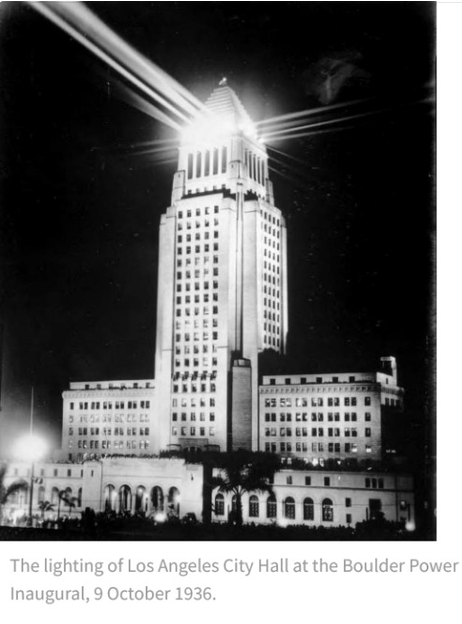
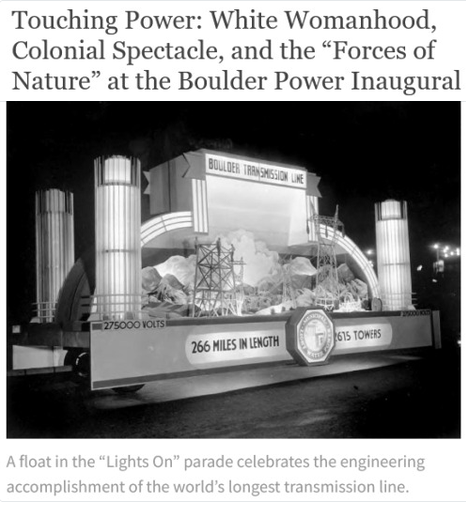
As the arc ignited by Scattergood’s “magic finger” was extinguished, LA’s iconic, art deco city hall was illuminated by a “billion candlepower” floodlight on the roof. In a moment underscoring what Nye describes as the particularly American conjunction of national exceptionalism and the technological sublime, floodlights from adjacent buildings powered on as a chorus sang the United States’ national anthem. Themes of conquest became literal in the next event of the evening, the “Lights On Parade.” Following a division of military bands, unnamed students from the nearby Sherman Institute, a residential school run by the Bureau of Indian Affairs, played roles in the “Prehistoric-Pioneer Days” pageant entitled “Aborigine Chief,” “Primitive Indians,” and “Indian Youths … Modern Trades.” Such residential schools were key to the government’s brutal policy of cultural annihilation, and the students’ public performance of “Indianness” to a largely White audience was framed by a heavy-handed “civilizing” narrative, beginning with the “primitive aborigine” and progressing through racially charged acts like “Cabrillo’s Ship,” “Peon Vendors,” and “Pioneers” before ending with the “Modern Trades,” implicitly powered by electricity from Hoover Dam.
All text, photos, and captions above by: Sarah Kanouse. “Touching Power: White Womanhood, Colonial Spectacle, and the “Forces of Nature” at the Boulder Power Inaugural.” Environment & Society Portal, Arcadia no. 34. 2021.