Who gets to be 'human' in 'the humanities'?: Black geographies, 'damned' people and places, academic epistemologies, and 'liberation pedagogy'

(Originally posted elsewhere in January 2022. Edited on 4 February 2023 after the most recent publication.)
A compilation. Thought they complimented each other nicely.
Here we have Kanwal Hameed, Katie Natanel, and Amal Khalaf on pedagogy and the contemporary university. (Sorry, this one's kinda long--but worth it!)
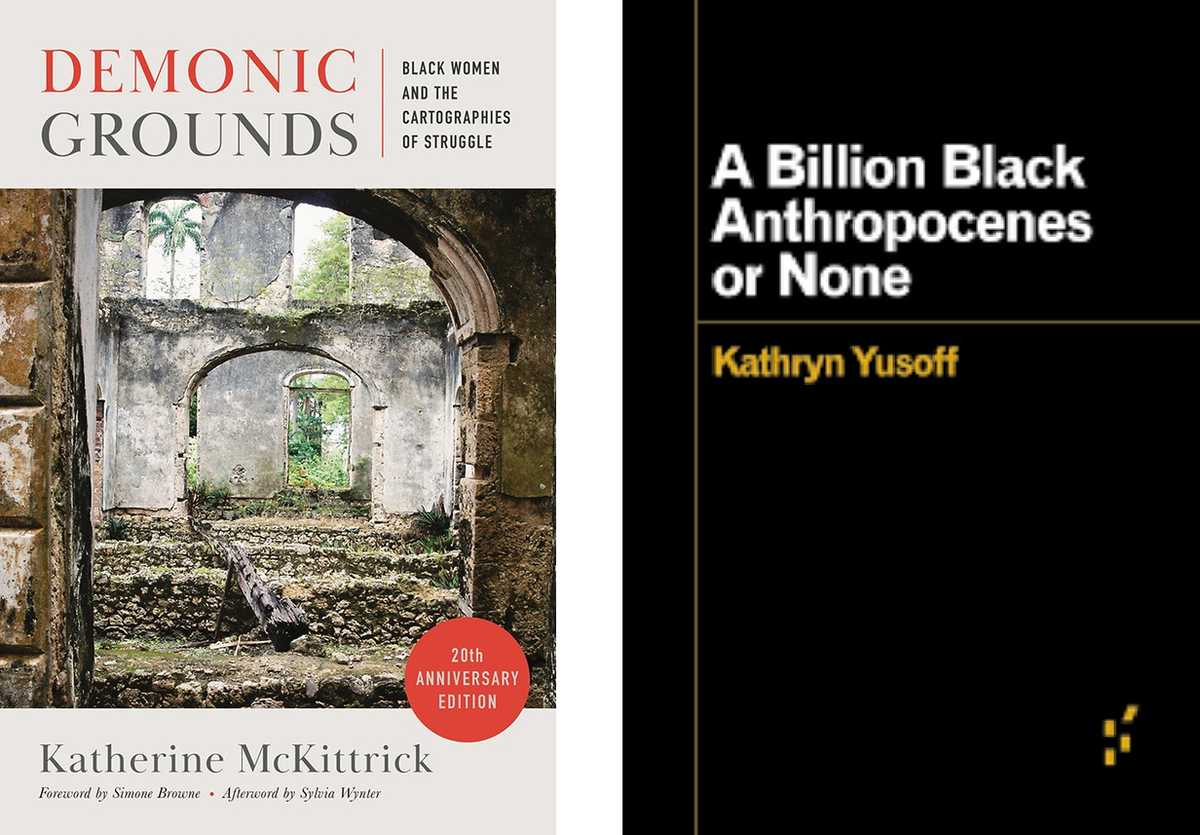
And then we have three separate excerpts from Kathryn Yusoff, Katherine McKittrick, and Iain Chambers, respectively, on legacies of "humanism" and racial inheritances of what Yusoff calls the "inhumanities." I thought that these three collectively bolstered the case made by Hameed, Natanel, and Khalaf.
--
Excerpt 1:
KN [Katie Natanel]: [...] I think what is sitting in my heart at this moment is how to hold this together: a will to do things otherwise and build things elsewhere, in ways that keep sight of power - and yet refuse it as totalising. This might be what María Lugones meant when she challenged us to work beyond “the logic of power” in her theorisation of/toward decolonial feminism. [...] What Lugones proposes (insists!) is not an abstract theoretical musing, something to be puzzled out by refracting ideas through frameworks. Rather, it is something to be done - a practice that we envision and embody because we must. [...]
KH [Kanwal Hameed]: [...] We are also drawing on a longer history of thinking about radical pedagogy ([...] Freire, Boal and more - including many unpublished practitioners). [...] [S]ituated as we are within colonial extractive institutions, what is our relation to knowledge? We can think with Michel-Rolph Trouillot about how this relationship - which is invested with power - is obscured, as knowledge travels, enters, and circulates within institutions [...]. How do we make choices about what we share? As we move through the business of knowledge production, do we ask ourselves: who needs to know this, and why? Trouillot says, “the ultimate mark of power may be its invisibility; the ultimate challenge, the exposition of its roots.” How can we keep the roots of meta-structures of domination and extraction clear and visible to ourselves, and at the same time work, as Chandra Mohanty says, as “insurgent” communities within our institutions? How can we develop working practices which honour the engagements we have with the peoples, lives, histories, ideas that we work with?
KN: Yes, we are coming to a shared concern: what does it mean to work “beyond the logic of power” and build “insurgent communities” within extractive institutions? What does that require of us? In other spaces and times, I’ve named academia and Higher Education as explicitly neoliberal, shaped by capitalist ideals to the extent that (successful) teaching and learning yields subjects who reproduce the prevailing order and the violence that sustains it. I know that among us, we follow Paulo Freire [...] in refusing that logic, and instead insist that education can be otherwise - that knowledge cultivation and sharing can move us toward “critical consciousness” (conscientização) and practices of freedom. [...]
---
KN: So the question is definitely one of method - how exactly do we work in these ways [...]? In The Undercommons, Stefano Harney and Fred Moten catch us with this claim: “THE ONLY POSSIBLE RELATIONSHIP TO THE UNIVERSITY IS A CRIMINAL ONE.” [...] Instead, Harney and Moten invite us into fugitivity:
[I]t cannot be denied that the university is a place of refuge, and it cannot be accepted that the university is a place of enlightenment. In the face of these conditions one can only sneak into the university and steal what one can. To abuse its hospitality, to spite its mission, to join its refugee colony, [...] to be in but not of - this is the path of the subversive intellectual in the modern university.
“To be in but not of.” This is to accept that our labour might be captured or extracted (even willingly) by the institution - that we might “be beneficial to capital” - but to do our work beneath the surface, refusing to serve its logics by “disappear[ing] into the underground.” This is a space/time of the future, where we are learning, building, nourishing, creating, and preparing for a new order. [...]
---
KH: [...] Through them, I am also asking: can we meet each other in other ways? At a morning MA seminar [on Palestine] [...], I began our session with a quick warm up game taken from the methods of Augusto Boal [...]. It encouraged members of the class to look at one another, and to lead by paying attention to and reading non-verbal cues. At the same time, it occurred to me that the exchange was still being shaped by other power dynamics, including race, physical appearance and clothing, and dis/ability. For a myriad of reasons, people don’t necessarily always want to be seen, or known. [...] This approach to learning involves grappling with discomfort and learning to de-centre. Teaching students to de-centre themselves - by asking who is known? who is know-ing? who is know-er? [...]
---
KN: These are worlds we can build and inhabit - they hold what was, what is, and what will be. They are spaces of secrecy, criminality and solidarity, revolt, retreat, and release. They are sites of study and strategy, offering care, love, nourishment, and pleasure. These fugitive worlds are where we meet and dream together - where we hold each other up when the doing feels too much, where we take turns carrying the weight. They are not ephemeral, but rising and receding according to our needs and careful judgement/s of the moment. We can be there learning, agitating, disrupting, growing, and laughing - and at the same time here, rising to the surface to steal what we can.
I am starting to understand how we might create these worlds with people we meet through the extractive institutions we work in (but are not of) - on picket lines [...], in classrooms and hallways, at protests and workshops - in time that may be “stolen” by virtue of the systems and norms that define criminality, but in truth is reclaimed, re-purposed, and re-valued. Finding our communities can be an act of recognition, seeing/hearing/feeling/sensing yourself in another (even if a fleeting glimpse) or something more radical: recognising “[…] that this shit is killing you, too, however much more softly.” I think this is partly what leads us toward decolonial and anticolonial feminist praxis, pedagogies, and thought: the belief that when we work in antithetical ways we are also in motion toward each other.
---
All text above, the words of: Katie Natanel, Kanwal Hameed, and Amal Khalaf. “Toward a Liberation Pedagogy.” Kohl. Volume 9 Number 1. Special Issue: Anticolonial Feminist Imaginaries. Winter 2023. Published at: kohljournal dot press slash toward-liberation-pedagogy [Emphasis mine.]
--
Excerpt 2:
The idea of the plantation is migratory. [...] Past colonial encounters created material and imaginative geographies that reified global segregations through “damning” the spaces long occupied by Man's human others. Here, damning can be understood in two interlocking ways: as a fencing in and as a condemnation of racial-sexual difference. The uninhabitable - in particular, the landmasses occupied by those who, in the fifteenth and sixteenth centuries, were unimaginable, both spatially and corporeally - is the geographic (non)location through which the plantation emerged. From Caliban's “uninhabited” island in Shakespeare's The Tempest, to the regions within Africa identified as too hot to be livable, the landmasses deemed uninhabitable presented a geographic predicament upon “discovery.” [...] [A] "new symbolic construct of race," which coincided with post-1492 colonial arrangements, organized much of the world according to a racial logic. [...] The colonial enactment of geographic knowledge mapped “a normal way of life” through measuring different degrees of humanness and attaching different versions of the human to different places. […] [I]n the sites of toxicity, environmental decay, pollution […] inhabited by impoverished communities […] the [current] geographies of the racial other are emptied out of life precisely because the historical constitution of these geographies has cast them as lands of no one. So in our present moment, some live in the unlivable, and to live in the unlivable condemns the geographies of marginalized to death over and over again. Life, then, is extracted from particular regions […]. If we believe that the city [the prison, the resort, other "postcolonial spaces"] is the commercial expression of the plantation and its marginalized masses, and that the plantation is a persistent but ugly blueprint of our contemporary spatial troubles, Wynter's essay asks that we seek out secretive histories […]. [R]acial violence haunts, [...] the struggles we face, intellectually, are a continuation of plantation narratives that dichotimize geographies into us/them and hide secretive histories that undo the teleological [...] underpinnings of [colonial, imperial, modern] spatiality.
Text by above by: Katherine McKittrick. “Plantation Futures.” Small Axe, Volume 17, Number 3, November 2013 (No. 42), pages 1-15. [Emphasis mine.]
--
Excerpt 3:
Registering the marine world as central to the making of modernity - from slave ships and sea-borne empires to container logistics and the industrialized extraction of its resources (from fish to fossil fuels) - we encounter the constant of colonialism in the haunting racism that produces the violent grammar of inhospitality, today etched on the body of the contemporary migrant. [...] This is to interrupt and rework Occidental historiography, sociology, and philosophy, and to puncture their faith in rendering the world transparent to their will. […] Promoting the instability of critical language is to take responsibility for what Achille Mbembe calls the becoming-black of the world: where the production of subjection provokes alternative knowledge, practices, and politics […]. Today the increasing use of drones in the Mediterranean as part of the technology of governance marks the latest abandonment of social responsibility to the bio-surveillance of unwanted bodies and discarded lives. Smart borders take migrants far below the category of “bare life,” [...] and extends the racial profiling written into the historical premises that betray their deep incubation in the refusal to register the languages and limits of the white myths [...]. From the Black Atlantic to the Black Mediterranean: seas of dispossession and unbelonging have constantly demonstrated the political, juridical, and onto-epistemological limits of modernity. They promote a constant critique of the epistemic foundations of Western [colonial "liberalism"]. Those on the water, the wretched of the sea, the damned [...], who cannot source their identity in the territory of the nation-state, are without rights. They have no social [...] validity. [...] Yet they simultaneously [...] exist, persist, and resist. [...] The algorithm sputters in the dark while cut-up, bricolage, collage, and montage work the critical gaps [...]. The archives unwind to expose other computations of time and further folds in space: the promise of foreign cartographies [...].
Text above by: Iain Chambers. A section by Chambers in the essay co-authored by Tiziana Terranova and Iain Chambers. “Technology, Postcoloniality, and the Mediterranean.” e-flux Journal Issue #123. December 2021. [Emphasis mine.]
--
Excerpt 4:
T]he framing of the inhumanities forces a reckoning with the humanist liberal subject that orders the humanities: an invisible and indivisible white subject position [...]. In Césaire’s (2000 [1972]) Discourse on Colonialism, he suggested that “at the very time when it most often mouths the word, the West has never been further from being able to live a true humanism [...]”. In another searing critique of [White, European, liberal/colonial] humanism, Fanon (1961) tied the unrealized figure of a true humanism to the earth, as a wretched counterpoint, whereby the inhuman residues of the colonial project abide as discarded matter […]. Those blackened colonial afterlives in “modernity’s project of unfreedom” (Walcott 2014, 94) are still very much present in the political geologies of climate change vulnerabilities, the wasting effects of racial capitalism, and neo-extractivist economies […]. The narrative arc of humanism, Scott (2000) suggested in conversation with Wynter, is often told as a kind of European coming-of-age story. […] The Anthropocene discourse follows the same coming-of-age humanist script [...]. Sylvia Wynter, W.E.B. DuBois, and Achille Mbembe all showed how that genealogy of man [as universal concept] was underscored by the racial division of life and nonlife. […] In its simplest iteration, there are forms of life on one side and nonlife on the other; nonlife that is constituted through death, and more recently in Mbembe and Povinelli’s writing through forms of social death, exhaustion, and extinguishment, wherein nonlife emerges as a zone of governance. The gravitational pull that centers these divisions between life and nonlife is the human subject as it is conceived through a Western normative frame [...]. As new forms of racialized beings were articulated through sixteenth- through nineteenth-century paleontology in the context of colonialism, geology was also articulating new origins of the earth, as well as forming the material praxis of their rearrangement (through mining, ecological rearrangements and extractions, and forms of geologic displacements such as plantations, dams, fertilizers, crops, and introduction of “alien” animals). [...] Historically, this normative sphere of humanism was racist and specifically antiblack, and without challenging that history, it remains so, every time the universal or human is invoked. Some of the greatest challenges, of course, came from anticolonial thinkers struggling to make sense of their painful histories in their fullest terms, such as Fanon (1959, 1961), Césaire, Glissant, C. L. R. James and Wynter. As Wynter (2000) commented, “The degradation of concrete humans, that was/is the price of empire, of the kind of humanism that underlies it” (154). For Wynter (2000), “what is called the West [...] begins with the founding of post-1492 Caribbean” (152). Wynter challenged the geographical imaginary that the Americas and Caribbean are somehow an epistemological outside to Western knowledge […].
Text above by: Kathryn Yusoff. “The Inhumanities.” Annals of the American Association of Geographers, Volume 11, Issue 3. November 2020. [Emphasis mine.]
--
Excerpt 5:
But what becomes of the native-occupied “uninhabitable” zones is a geo-racial reorganization. The “new symbolic construct of race,” which coincided with post-1492 colonial arrangements, was spatially organized according to a new […] logic. […] That is, the uninhabitable […] is underscored by racial and sexual differences. To transform the [land] […], and make this transformation profitable, the land must become a site of racial-sexual regulation, a geography that maps “a normal way of life” […] This is expressed through uneven geographies: spatial arrangements [...]. The inhabitability [...] also produces [...] forms of geographic nonexistence, which differ from what was assumed was "not there." [...] [W]hat Edouard Glissant describes as the "real but long unnoticed" places [...]: cultural sharings, new poetics, new ways of being [...]. Those who occupy the spaces of Otherness are always already encountering space and therefore articulate how genres or modes of humanness are intimately connected to where we/they are ontologically as well as geographically. To return to an earlier discussion, spaces of Otherness are “palpitating with life.” [...]
Text above by: Katherine McKittrick. “Demonic Grounds: Sylvia Wynter.” Demonic Grounds: Black Women and The Cartographies of Struggle. 2006. [Emphasis mine.]