'You've got to remember what the clouds cannot forget' and 'find a secret name and fight with it': Historicity and two elegies from postcolonial Caribbean ecocriticism
(Originally posted elsewhere on 5 August 2020.)
Two elegies, considered together.
--
Excerpt 1:
Hay que aprender a recordar / Lo que las nubes no pueden olvidar
You’ve got to learn to remember / what the clouds cannot forget
Nicolas Guillen’s insight, from his 1947 poem “Elegia,” captures one of the central paradoxes of Caribbean literature. He states plainly, “hay que aprender,” which implies a more generic mandate than the English translation can provide. “One must remember” or “we must all remember” or “it must be remembered” are all possible translations of the imperative to record and to commemorate a history […]. The vague subject of the imperative is appropriate, since it is not clear who will be capable of remembering […]. Despite this uncertainty, the mandate remains […]. The clouds have witnessed the devastation of Indigenous populations, the violence of the Middle Passage, and a host of other human atrocities in the Caribbean […]. Guillen’s work […] might be read as a response to the […] radically altered […] human and botanic migration, transplantation, and settlement [of] the Caribbean. This unique and troubled history has caused theorists such as Edouard Glissant to conclude […] that the Caribbean “landscape is its own monument: its meaning can only be traced on the underside. It is all history.” […] Like Guillen, Glissant also suggests […] that a gesture of destruction against land becomes an act of violence against collective memory. […]
While the brutality of the plantation system produced a particular relationship to the natural world, it is important to consider those sites that served as vital repositories of Indigenous and African beliefs and assertions of rebellion against plantation […]. This is […] evident in the history of Indigenous and slave resistance in which mountain ranges, mangrove swamps, provision grounds, and other sites of environmental opposition to the plantocracy provided vital alternative communities.
—
Despite the intense scrutiny and narrative interpellation of tropical environments, these landscapes continue to be misunderstood for reasons that can be traced to the early Caribbean colonists. […] In an effort to decolonize Caribbean histiography, the revitalization of folk culture […] has provided a regenerative framework for both human and natural histories […]. For instance, Aime Cesaire has drawn extensively from botanical history […], while Eric Roach’s poetry explores the “glorious landscaprs of the soul” […]. Brathwaite’s seminal work on “nation-language” specifically links the Caribbean “folk/metaphysical mind” to arboreal and other natural images derived from “African symbolism” […]. Andrew Salkey observes […] in Haiti: “The land … is his own way of claiming to have a history which includes past and present and insures the future.” […]
From colonial interpellations of tropical island Edens to the legends of El Dorado, the narrative teleology of conquest has produced a utopic counterpart that often positions itself outside of the Euclidean violence of the plantation systems. The notion of Caribbean origins is tied to a long history of mythologizing nature […]. One finds ample testimonies from Chr*stopher C*lumbus, Am*rigo V*spucci, and F*rnandez de Ovi*do likening the Antilles to the Greek “Blessed Isles.” […] This produced a gendered division between the space/time of Europe and the feminized, “primitive” tropics that erased the historical depth of the New World and helped to perpetuate the myth of European innocence in the hemisphere. […] Even as [Alexander von] H*mboldt drew from Caribbean nature to construct “nations of plants” and to theorize “a new kind of planetary consciousness”, these were already deeply entangled in colonial hierarchies.
—–
Due to colonial and tourist views of the islands as ahistorical, passive, and idyllic landscapes, Caribbean writers have had to recover a sense of historicity. […] Many writers have re-envisioned a more “natural” […] Caribbean archipelago by turning to biogeography. As Chris Bongie points out, “the topos of the island” lends itself to […] “a fragment, a part of some greater whole from which it is in exile […].” To make regional claims to the broader archipelago and the Americas, Brathwaite has asserted that the islands’ “unity is submarine” […] to destabilize the colonial balkanization that segregates the region into colonial language groups […].
In the words of Jean “Binta” Breeze, “under this ocean / we hold hands.”
Literature is by no means the only way to establish a sense of place, but its rhetorical recovery of a sense of history […] can play a crucial role […]. As Edward Said suggests about postcolonial representation, “the land is recoverable at first […] through the imagination.” […] [B]elonging in the Caribbean landscapes means engaging in historical reconstructions […]. We become aware, then, not so much of the concrete historical density embedded in nature but of our own participation in creating a sense of place. […] Derek Walcott expressed this redemptive value […]: “Break a vase, and the love that reassembles the fragments is stronger than the love which took its symmetry for granted when it was whole.” […] Glissant hopes that Caribbean literature can teach the political force of ecology; that is, that literature can recapture ecology’s radical articulation of “the relational interdependence of all lands […].”
—
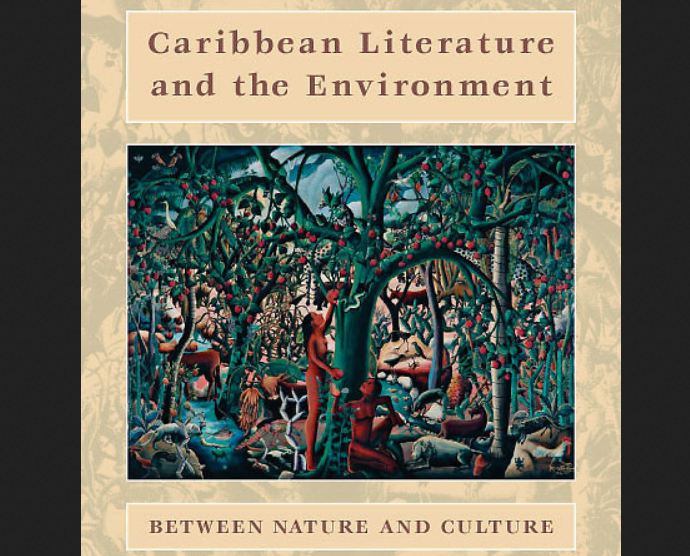
Text above by: Elizabeth M. DeLoughrey, Renee K. Gosson, and George B. Handley, “Introduction," in Caribbean Literature and the Environment: Between Nature and Culture (University of Virginia Press, 2005).
--
Excerpt 2:
By the time of its publication in 1989, Eloge de la Creolite signaled a departure from the earlier […] movements […] [and an] embrace of a cultural theory […] linked to and anchored in Caribbean ecology. Eloge de la Creolite displays a remarkable sensitivity to the role that imperialism played in fashioning […] understandings of human subjectivity and the environment and the neo-colonialist forms of exploitation which continue to threaten […] the environment […] of these islands. […] Eloge de la Creolite insists […] French Antilleans can […] “look positively at all that pulsates around us” […]. This passage alludes to the interlocking histories of both the French Caribbean [island ecologies] and the people who inhabit them: […] Indigenous populations; the forced migration and enslavement of African slaves […]; the decimation of the islands’ flora and fauna and the introduction of non-native monocultural crops […]; French colonial rule and its assimilationist tendencies […]. To demonstrate his point, Glissant articulates a spatio-temporal poetics in which landscape and other ecological metaphors are linked to history and memory, particularly in his 1958 novel La Lezarde and later in Mahagony (1987). […
—
Published two years after Eloge de la Creolite […], Patrick Chamoiseau’s Texaco is […] [a] concrete and complete elaboration of the ideals of Creolite. […] While culturally specific to Martinique, the Texaco community […] is the very condition of possibility for […] survival. […] [A]s the novel opens we are told that “to escape the night of slavery and colonialism, Martinique’s [communities] will, one generation after another, abandon the plantations, the fields […].” In Texaco, there is no barrier between landscape, history and person. Each is an integral and constitutive part of the other. […]. Texaco is the name of this “space of placedness” for community and [a leading character] Marie-Sophie’s secret name:
So I took a a deep breath […] and […] I named myself a secret name. It came to my mind with natural simplicity. When it rang in my head, I felt my languors disappear, my hair stand on end […]. At the center of a flood of words bustling in my head, my secret name began to throb in lewoz rhythm which shook my bones […].
[T]he Texaco quarter is not just a flattened slate available and waiting for human inscription. Nor is it just a particular urban space standing as a bulwark against colonialist discourses aimed at assimilating Creole language, culture and traditions into the dominant French “order” […]. In concrete terms, Texaco as habitus is the generative source of action and thought for […] the community. […] Marie-Sophie’s gesture – whittling bamboo, packing down the earth […] – concretize the improvisation and innovation inherent in the habitation of place. Texaco is “embodied history […]. It is the active presence of the whole past […].” Place and Self […] are thoroughly enmeshed, not fused into a singular essentialized whole. There is a continual reshaping and reconnecting […]. In the words that the Old Black Man of the Doum maroon community offered as council to Marie-Sophie, “Find yourself a secret name and fight with it.” (”Fight” here translates the original text’s use of the French verb for to beat / pulsate, as in sense of a beating heart.) […]
—
Facing this undulating land […], Marie-Sophie accesses the liminal space of the interrelations of identity, community and the non-human, environmental elements […]. It is in this liminal space, this bridge between historicized cultural encounters on, in and through colonized landscapes that the ceaseless process of exchanging transformation which marks the Caribbean’s “irruption into modernity” takes place […].
—
In representing the critical entanglements of the human and non-human environmental elements […], Chamoiseau offers a […] portrait of the particular ways in which both human and environmental cultures absorb, recuperate, divert, struggle with, let slip, and (re)appropriate the sedimentation of human and natural history without being wholly or predictably circumscribed and subsumed by the other.
And while Marie-Sophie describes her modest hutch as “nothing, just something against the sun,” this hustch, her habitation, “it was my anchor in City. I was entering myself directly into that very old struggle.”
—
Text by: Keithley P. Woolward, “Patrick Chamoiseau’s Texaco or the Ecology of Caribbean Identity,” Journal of West Indian Literature, vol. 24, no. 2 (November 2016). [Emphasis mine.]